
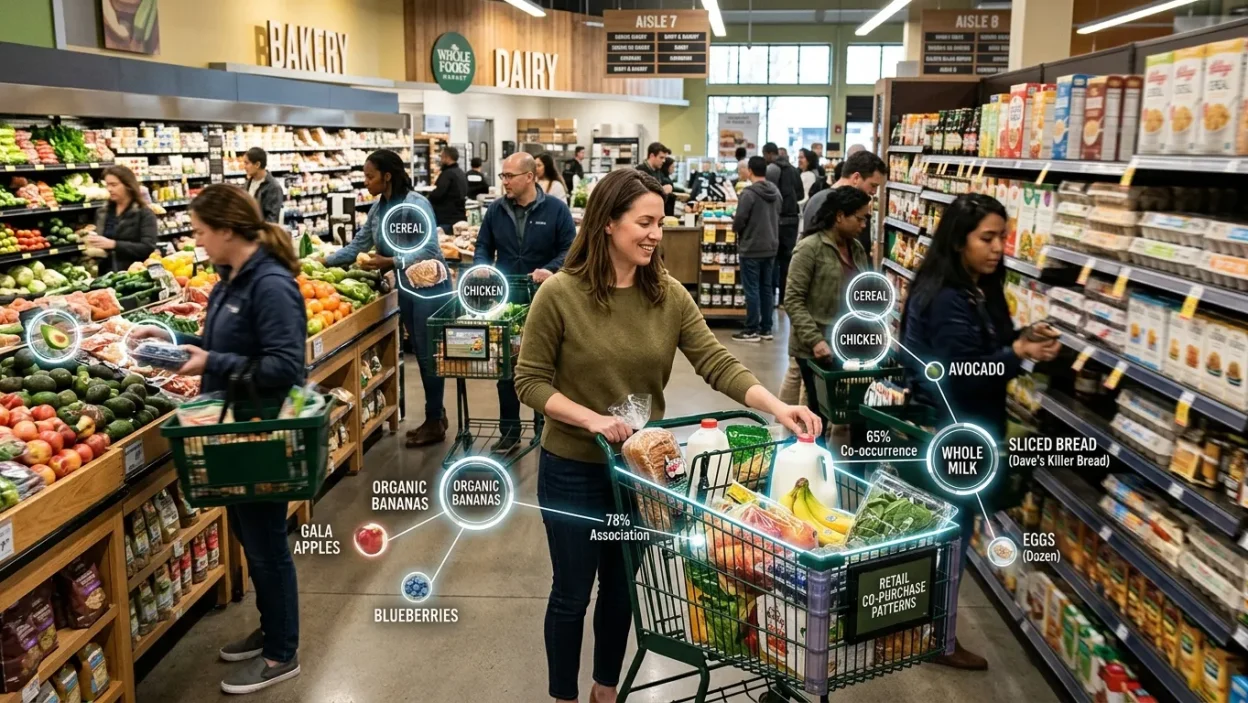
Applying market basket analysis to student data reveals hidden learning patterns, eliminating digital clutter and transforming modern education through profound calm and sustained academic focus.
This comprehensive guide explores how applying association rules and data mining to educational resources streamlines student workflows. You will discover practical implementation strategies, key algorithm concepts, and actionable insights to foster a deeply focused, distraction-free learning environment for every student.
The Intersection of Data Science and Educational Calm

The modern digital classroom offers an overwhelming amount of information. Students constantly navigate through diverse portals, assignments, video lectures, and reading materials. This sheer volume of resources often leads to cognitive overload, anxiety, and a fragmented attention span. To combat this digital fatigue, institutions are turning to advanced predictive modeling. By utilizing market basket analysis, educators can fundamentally redesign how information reaches the learner.
Originating in the retail sector to determine which products consumers frequently purchase together, this analytical method translates perfectly to educational platforms. Instead of tracking consumer goods, schools track educational resources, digital tool usage, and course enrollments. When administrators understand which study materials students access simultaneously, they can bundle these resources seamlessly. This proactive bundling prevents the student from wasting mental energy searching for related materials.
Reducing Cognitive Load for Students
Every decision a student makes about where to click, which file to download, or which video to watch drains their finite daily reserve of willpower and focus. Cognitive load theory suggests that learning environments should minimize extraneous mental effort. Applying market basket analysis to Student Data Systems allows instructional designers to predict exactly what a learner needs next.
If data shows that students who access a specific biology lecture video also frequently download a particular chemistry glossary, the learning management system can automatically present both items together. The student no longer searches through nested folders. They experience a frictionless journey. This smooth, predictable interface removes frustration, lowering stress levels and allowing the student to remain entirely focused on the academic material itself.
Eliminating Digital Distractions
Distractions in online learning do not just come from social media; they also come from poorly organized course interfaces. When a platform is cluttered, students lose their train of thought. Using market basket analysis helps institutions identify the “frequent itemsets” of the academic world. By isolating the exact combinations of tools and texts that yield the best academic performance, schools can strip away the unnecessary elements from the screen.
When the interface only presents highly relevant, statistically correlated study materials, the visual and mental noise disappears. Students experience a profound sense of calm. They log into their dashboard, find their tailored learning path immediately, and engage in deep work without the constant temptation to click away or hunt for missing context.
Core Concepts of Association Rules in Learning
To fully harness the power of this methodology, educators and data scientists must understand the foundational metrics that drive the algorithm. These metrics—support, confidence, and lift—determine the strength and reliability of the resource combinations being recommended to the students.
Understanding Support in Education
Support measures the baseline frequency of a specific combination of items within the entire dataset. In a retail setting, it measures how often bread and milk are bought together out of all store transactions. In our educational context, support measures how often two specific learning modules are accessed together out of all student sessions.
For example, if an online academy has ten thousand active learners, and two thousand of them access the advanced algebra module alongside the physics lab simulation, the support for this combination is twenty percent. High support indicates a widespread trend among the student body. Identifying these high-support combinations through market basket analysis ensures that broad curriculum changes will positively impact a large portion of the school population, creating a more cohesive and logical learning sequence for the majority.
Measuring Confidence for Predictive Accuracy
Confidence measures the conditional probability that a student will access a secondary resource given that they have already accessed a primary resource. It indicates the reliability of the predictive rule. If data shows that eighty percent of students who read a historical text on the Industrial Revolution immediately open a documentary video on the same topic, the confidence of that association rule is eighty percent.
High confidence is critical for maintaining a calm learning environment. If the system recommends a resource with low confidence, the student might find it irrelevant, leading to confusion and broken focus. By strictly enforcing high-confidence rules generated via market basket analysis, Curriculum Optimization teams guarantee that the suggested learning paths feel intuitive and highly personalized to the student’s immediate academic needs.
Evaluating Lift for Meaningful Connections
Lift evaluates the strength of the association between two resources by comparing their observed co-occurrence against their expected co-occurrence if they were completely independent of one another. A lift value greater than one means that the resources are genuinely connected in the students’ learning habits, rather than just randomly accessed together.
For instance, a general introductory syllabus and a universal grading rubric might be accessed together frequently, but since every student needs them, the lift might be low. Conversely, a highly specific statistics formula sheet and a niche programming tutorial might have lower overall support but a massive lift, indicating a strong, specific connection. Using market basket analysis to uncover high-lift rules allows educators to create highly specialized, highly focused study bundles for advanced or niche topics, keeping specialized learners entirely engaged.
Implementing the Apriori Algorithm for Curriculum Design

The most common computational method for discovering these association rules is the Apriori algorithm. This algorithm systematically processes vast amounts of transaction data to find frequent itemsets. By bringing this algorithm into the educational sphere, institutions can automate the heavy lifting of curriculum alignment.
Data Collection and Preprocessing
Before any algorithms can run, schools must gather and clean their data. This involves extracting logs from Digital Learning Platforms, tracking login times, file downloads, forum interactions, and video watch times. Every student session acts as a “transaction,” and every resource accessed acts as an “item.”
This raw data is often messy. Preprocessing requires removing administrative logins, filtering out accidental clicks, and standardizing the nomenclature of course files. A robust market basket analysis relies entirely on the accuracy of this initial dataset. Clean data guarantees that the resulting associations reflect genuine student learning behaviors rather than system glitches or required administrative tasks.
Generating Frequent Itemsets
Once the data is preprocessed, the Apriori algorithm scans the sessions to identify frequent itemsets based on a minimum support threshold set by the administrators. The algorithm works iteratively. First, it finds all single resources accessed frequently. Then, it looks for pairs of resources, then triplets, continually scanning the database.
This iterative process builds a comprehensive map of how knowledge connects in the minds of the students. It might reveal that students struggling with calculus frequently return to a specific foundational geometry video. By using market basket analysis to surface these frequent itemsets, teachers gain unprecedented insight into the actual, rather than theoretical, learning paths their students take.
Comparison Table: Traditional vs. Predictive Course Design
|
Feature / Aspect |
Traditional Course Design |
market basket analysis Design |
Impact on Student Focus |
|---|---|---|---|
|
Resource Grouping |
Based on instructor intuition |
Based on actual student usage data |
Highly relevant materials keep students engaged |
|
Interface Clutter |
High; all resources visible |
Low; only correlated resources shown |
Reduces visual anxiety and promotes calm |
|
Learning Path |
Rigid and linear |
Dynamic and responsive |
Prevents frustration from irrelevant content |
|
Discovery Time |
Minutes spent searching |
Instantaneous access |
Preserves cognitive energy for actual learning |
|
Adaptability |
Updated yearly or per semester |
Updated continuously based on data |
Maintains relevance as student needs shift |
Applying Insights to Create Focused Environments
Discovering association rules is only the first step. The true transformation occurs when these insights are actively applied to the daily educational experience. Restructuring the digital environment based on data radically shifts the student experience from chaotic to profoundly calm.
Dynamic Dashboard Personalization
Imagine a student logging into their educational portal. Instead of a static list of all available courses and thousands of files, the dashboard dynamically adjusts. Because the system runs continuous market basket analysis, it knows that a student opening an essay prompt usually needs the citation guide and the digital library portal.
These exact tools appear instantly on the screen. The student does not navigate through menus. This level of personalization feels intuitive and supportive. It wraps the student in an environment tailored exactly to their current task, completely removing the administrative friction that traditionally shatters academic focus.
Strategic Assignment Bundling
Educators can proactively design assignments based on known data patterns. If historical analysis shows that a significant cluster of students successfully grasps a complex physics concept only when they also engage with a specific interactive simulation, the teacher can permanently bundle these items into a single assignment module.
This ensures that future students do not have to struggle to find the missing piece of the puzzle. They are handed the complete “basket” of required knowledge upfront. Utilizing market basket analysis for assignment bundling accelerates comprehension, reduces the anxiety of falling behind, and allows the classroom to operate with a unified, focused momentum.
Pro Tips for Implementing Data-Driven Learning
Integrating advanced algorithms into an educational setting requires finesse. Here are expert strategies to ensure your transition to a data-backed curriculum yields the highest possible benefits for student well-being and academic focus.
Start with High-Traffic Gateway Courses
Do not attempt to analyze the entire university database at once. Begin your market basket analysis with massive, introductory gateway courses like Freshman Composition or Introduction to Psychology. These courses generate the largest volume of data, providing the most reliable and statistically significant association rules. Optimizing these courses first provides the greatest immediate reduction in student stress across the broader campus population.
Combine Quantitative Data with Qualitative Feedback
Algorithms tell you what students are doing, but they do not always tell you why. If your data shows a high correlation between a biology lecture and a forum on time management, do not just bundle them blindly. Speak to the students. You might discover the biology lecture is overly long and causing panic. Use market basket analysis to find the symptoms, but use human empathy and qualitative surveys to diagnose and cure the underlying educational friction.
Ensure Transparent Data Practices
Students must feel safe in their digital environments to maintain calm focus. If they feel surveilled, their anxiety will spike. Be completely transparent about how you track their platform usage. Explain that the institution uses market basket analysis solely to improve their interface and streamline their study materials. When students understand the technology is there to reduce their cognitive load, they will engage more naturally with the platform.
Common Mistakes to Avoid in Educational Data Mining

While predictive modeling offers incredible benefits, poor implementation can actually increase student frustration. Avoid these frequent pitfalls to maintain a supportive and focused learning atmosphere.
Setting Support Thresholds Too Low
If administrators set the algorithm’s minimum support threshold too low, the system will generate thousands of weak, coincidental association rules. A student might accidentally click a French literature file while studying chemistry. If the system records this and starts recommending poetry to chemistry students, the interface becomes chaotic. Always ensure your market basket analysis utilizes strict support thresholds to guarantee that only deeply established, meaningful patterns affect the user interface.
Ignoring the Temporal Aspect of Learning
Retail purchases often happen all at once at the checkout counter. Learning, however, is sequential. A student reads chapter one on Monday and chapter two on Wednesday. A standard algorithm might bundle them together simultaneously. Ignoring this timeline overwhelms the student with future materials. Advanced implementations of market basket analysis in education must account for sequence, ensuring that resources are recommended at the precise moment they are needed, rather than all at once.
Over-Automating the Curriculum
While data should inform curriculum design, it should never entirely replace the educator. An algorithm might notice that students skip a difficult reading assignment and go straight to the summary video. If the system automatically removes the reading assignment to “streamline” the basket, the academic rigor degrades. Market basket analysis should highlight student behavior, but teachers must ultimately decide if that behavior should be accommodated or corrected to preserve the integrity of the education.
Fostering a Culture of Deep Work
The ultimate goal of applying data science to education is not just technological efficiency; it is pedagogical philosophy. We are striving to teach students how to engage in “deep work”—the ability to focus without distraction on a cognitively demanding task.
When an institution actively curates the digital environment, removing the noise and presenting only highly correlated, essential materials, they are modeling focus. The interface itself becomes a silent teacher. It demonstrates that calm, methodical engagement is superior to frantic multitasking. By refining the learning ecosystem through market basket analysis, we give students the mental space required to think critically, process deeply, and master complex subjects without the constant hum of digital anxiety.
The Future of Predictive Educational Modeling
As machine learning algorithms become more sophisticated, the application of association rules will evolve from broad curriculum design to hyper-individualized learning paths. We will move beyond tracking what the average student needs, to predicting exactly what a specific individual requires based on their unique, real-time interactions with the platform.
The integration of real-time market basket analysis will allow educational interfaces to morph and adapt second by second. If a student pauses on a complex equation, the system will instantly offer the exact prerequisite tutorial that has historically helped similar students overcome that specific hurdle. This continuous, invisible support net will fundamentally redefine the academic experience, turning every digital classroom into an oasis of profound calm, absolute clarity, and limitless focused potential.
Conclusion
Harnessing market basket analysis empowers institutions to strip away digital clutter and build incredibly intuitive learning environments. By predicting resource needs and streamlining workflows, we protect students’ cognitive energy, replacing academic frustration with deep, sustained focus. Implement these data-driven strategies within your platforms today to cultivate a profoundly calm and highly successful educational ecosystem for every learner.
Frequently Asked Questions
1. What exactly is market basket analysis in an educational context?
It is a data mining technique that analyzes student interaction logs to discover which digital resources, courses, or study materials are frequently accessed together during learning sessions, allowing institutions to group them logically.
2. How does predicting resource usage help reduce student anxiety?
By automatically presenting the exact files and tools a student needs for a specific task, it eliminates the frustration of navigating complex folders, reducing cognitive load and fostering a calm, focused mindset.
3. What does “support” mean when analyzing student data?
Support refers to the percentage of total student sessions that include a specific combination of resources. High support indicates a very common learning behavior that is shared by a large portion of the student body.
4. Can this type of analysis track individual student identities?
No, the analysis focuses on the aggregate behavior of items within sessions, not personal identities. It analyzes the “transactions” to find broad curriculum patterns while completely preserving individual student privacy.
5. What is the difference between confidence and lift in these algorithms?
Confidence measures how likely a second resource is accessed if a first one is opened. Lift measures the strength of that relationship compared to random chance, proving that the two resources are truly correlated.
6. Do I need a massive database to use market basket analysis effectively?
While larger datasets yield more reliable statistical patterns, even medium-sized course platforms can generate enough interaction logs over a single semester to identify meaningful resource associations and improve course layouts.
7. How does the Apriori algorithm work for digital learning platforms?
The algorithm systematically scans the database of student sessions, iteratively identifying single items, then pairs, then larger groups of resources that meet a pre-defined threshold for frequency, building association rules from the ground up.
8. Will implementing these predictive models replace human instructional designers?
Absolutely not. The algorithms highlight behavioral trends and streamline data, but human educators are essential to interpret why those trends occur and to ensure the recommended pathways maintain proper academic rigor.
9. What is a common mistake schools make when utilizing these algorithms?
A frequent error is setting the minimum support threshold too low, which causes the system to generate weak, coincidental resource links that clutter the interface and confuse students rather than helping them.
10. How quickly can a school see improvements in student focus after implementation?
Once the interface is streamlined based on the discovered association rules, institutions typically observe immediate reductions in support tickets regarding lost files, and a gradual, noticeable increase in sustained module engagement.





Embedded Finance and the Future of Seamless Digital Financial Services
The Importance of Risk Management in Modern Business
What Is Financial Technology (FinTech)? Everything You Need to Know
How Financial Technology Is Transforming Digital Payments
The Importance of Risk Management in Modern Business
How Financial Technology Is Transforming Digital Payments
How Digital Banking Is Changing the Future of Financial Management
How Financial Consulting Supports Sustainable Business Growth