
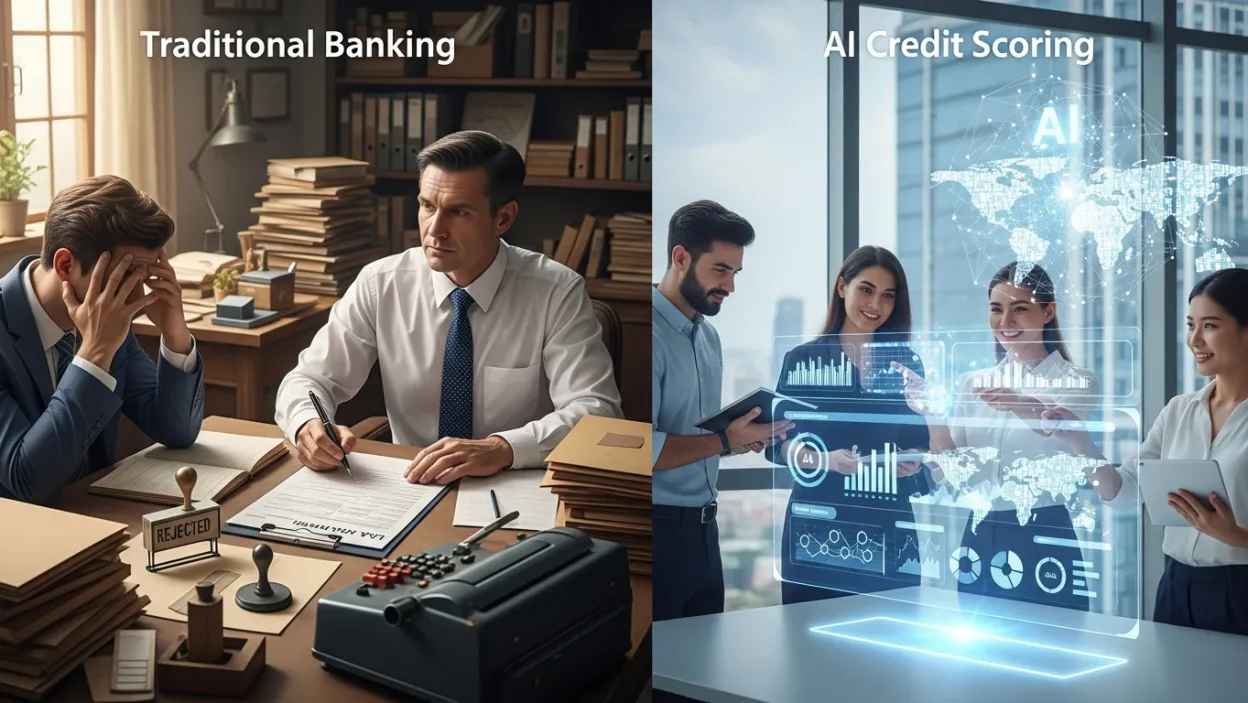
AI credit scoring is transforming SME banking by replacing slow, paper-based credit assessments with real-time, data-driven decision-making. By analyzing cash flow, transactions, and alternative data, AI enables faster loan approvals, personalized financing, and inclusive access to credit. This technology benefits both SMEs and financial institutions by improving accuracy, efficiency, and scalability across digital lending ecosystems.
With AI-based credit scoring, banks, fintech companies, and digital lenders can evaluate a business’s creditworthiness faster and more accurately. By leveraging machine learning, predictive cash flow analytics, and alternative financial data, SMEs can gain access to digital loans, embedded finance solutions, and AI-powered lending platforms directly within accounting software, ERP systems, or e-commerce tools.
This blog explores how AI-credit scoring works, its benefits for SMEs and financial institutions, the challenges involved, and the latest trends shaping the future of SME banking and fintech innovation.
AI Credit Scoring for SME Banking Ecosystem
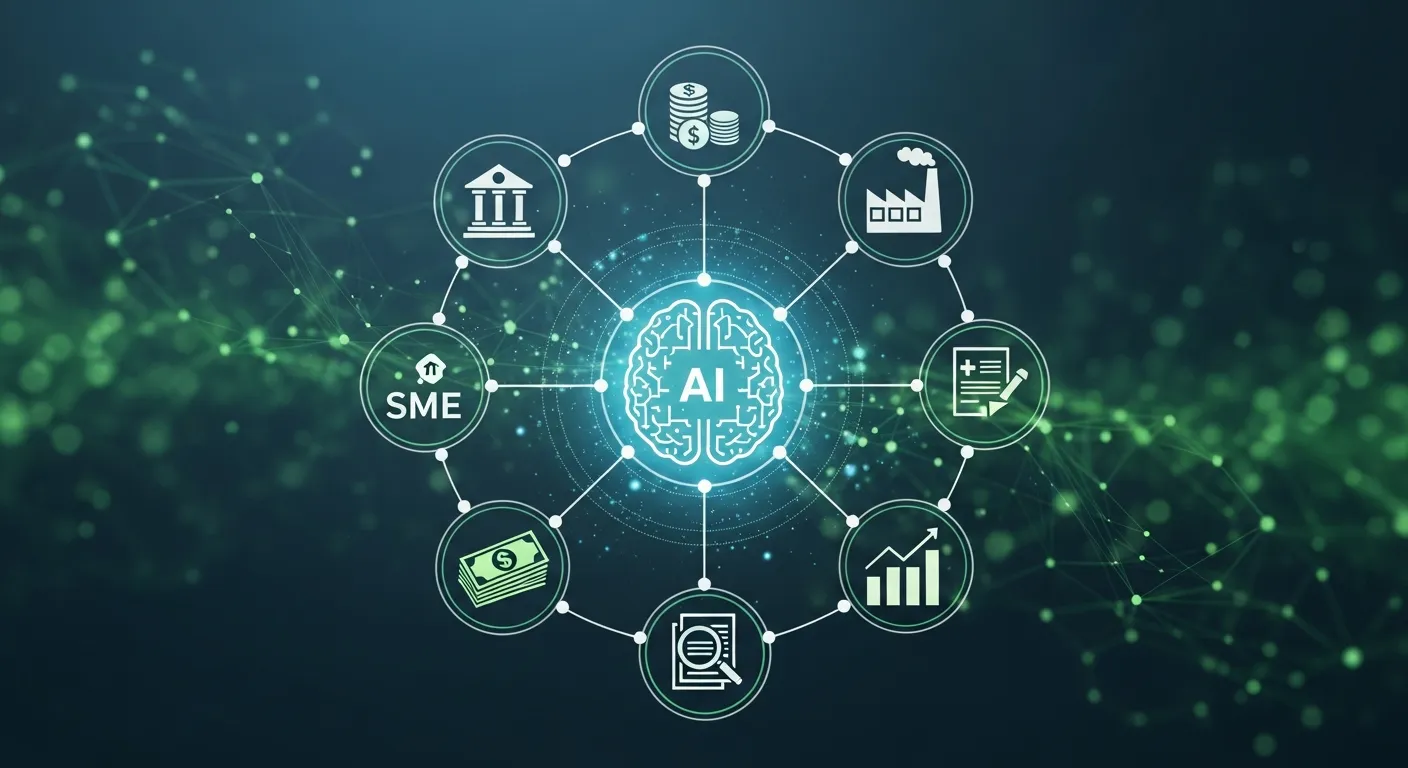
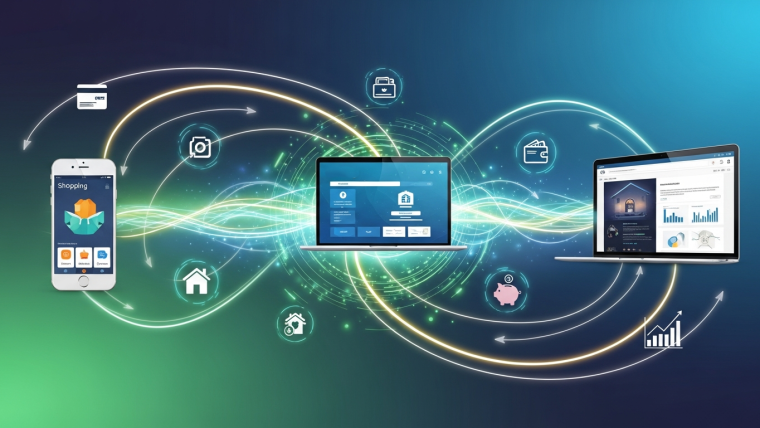
AI Credit Scoring for SME Banking creates a connected ecosystem where banks, fintech platforms, and SMEs operate seamlessly. By combining credit evaluation, lending, and cash flow insights into one system, AI reduces friction across the SME banking journey. This ecosystem enables faster funding access while improving transparency and trust for small businesses.
Why SME Banking Needs AI Credit Scoring?
SMEs face several challenges in getting financing:
-
Limited access to loans due to traditional credit scoring
-
Long waiting times for approvals
-
Lack of personalized financial advice
-
Complex compliance and documentation
-
Fragmented banking experiences
AI credit scoring helps solve these challenges. By analyzing alternative data, including cash flow trends, payment history, and digital transaction data, banks can make faster and more inclusive lending decisions.
Real-Time Lending Decisions for SMEs
With AI Credit Scoring for SME Banking, lending decisions shift from static reports to real-time evaluation. AI-driven systems continuously assess SME performance and instantly adjust credit approvals, limits, or terms. This real-time decision-making improves accuracy and helps businesses respond quickly to funding needs.
AI Credit Scoring for SME Banking Accuracy
AI Credit Scoring for SME Banking improves lending accuracy by replacing manual judgment with data-driven analysis. AI models evaluate real-time financial behavior, reducing human error and improving confidence in credit decisions. This accuracy benefits both lenders and SMEs seeking fair loan assessments.
How AI Credit Scoring Works?

1. Analyzing Alternative Data
AI credit scoring uses data beyond traditional credit reports. It evaluates:
-
Bank account and transaction history
-
Cash flow patterns
-
Payment behavior with suppliers and clients
-
Social and digital footprints
This approach identifies creditworthy SMEs that might be overlooked by conventional scoring methods.
2. Real-Time Risk Assessment
AI credit scoring assesses risk instantly. It detects unusual patterns and predicts potential defaults. This ensures smarter lending decisions and reduces loan defaults.
3. Predictive Cash Flow Analytics
Predictive Cash Flow Analytics enables AI systems to forecast future cash flow and identify potential funding gaps before they impact operations. By analyzing real-time transaction data, historical trends, and payment behavior, AI delivers forward-looking financial visibility for SMEs.
With Predictive Cash Flow Analytics, SME owners gain insights into:
-
Optimal times to request a loan
-
Best payment schedules to maintain liquidity
-
Risk of late client payments and cash flow disruptions
By leveraging Predictive Cash Flow Analytics, businesses can plan more efficiently, make informed financial decisions, and maintain long-term financial stability.
Cash Flow–First Lending Models
AI-driven lending models prioritize real-time cash flow over traditional balance sheets. By focusing on incoming and outgoing payments, lenders can better understand SME liquidity and offer financing aligned with operational realities. This approach supports healthier borrowing and repayment cycles.
4. Personalized Lending Recommendations
AI credit scoring provides tailored advice:
-
Recommended loan products for business growth
-
Optimal credit line limits
-
Cost-saving strategies
-
Investment planning for SMEs
This creates a personalized digital banking experience similar to having a dedicated financial advisor.
SME Credit Visibility and Insights
AI-powered platforms provide SMEs with visibility into their credit profile. Business owners can understand approval drivers, risk factors, and improvement areas. Clear insights empower SMEs to strengthen financial behavior and improve future financing eligibility.
Context-Aware SME Credit Evaluation
Modern AI systems evaluate SMEs in context, not isolation. Instead of relying on static snapshots, AI analyzes seasonal trends, industry benchmarks, and transaction behavior. This context-aware evaluation improves fairness and ensures SMEs are assessed based on real business performance rather than limited historical data.
Data-Driven Credit Limit Optimization
With AI Credit Scoring for SME Banking, credit limits are no longer fixed or outdated. AI continuously analyzes SME performance and adjusts credit limits based on real-time cash flow and revenue trends. This data-driven optimization ensures responsible and sustainable borrowing.
Adaptive Interest Rate Pricing
Adaptive Interest Rate Pricing allows AI-driven lending systems to adjust interest rates based on real-time SME risk and business performance. Instead of fixed pricing models, AI continuously evaluates cash flow stability, revenue trends, and repayment behavior to determine fair borrowing costs.
With Adaptive Interest Rate Pricing, SMEs benefit as improved financial performance leads to lower interest rates over time. This dynamic pricing approach rewards financially disciplined businesses, reduces long-term borrowing costs, and encourages sustainable growth while helping lenders manage risk more effectively.
AI in Digital Financial Decision Making

AI in Digital Financial Decision Making allows banks and fintech platforms to move beyond static credit evaluations. AI credit scoring enables real-time adjustments to loan terms, interest rates, and credit limits based on current SME performance. This adaptive approach supports smarter lending decisions while reducing financial risk for both lenders and small businesses.
AI and Machine Learning in Credit Scoring
AI credit scoring systems rely heavily on AI and Machine Learning to process large volumes of financial and behavioral data. Machine learning models continuously learn from SME transaction history, repayment patterns, and cash flow trends to improve credit risk assessment. This dynamic learning process enables lenders to make faster, more accurate, and scalable lending decisions.
Automation in SME Banking
1. Faster Loan Approvals
Automation speeds up loan processing:
-
Auto-verification of documents
-
AI-driven credit risk evaluation
-
Real-time application updates
Loans that once took weeks can now be approved in hours or even minutes.
2. Invoice and Payment Automation
AI and automation tools can:
-
Track invoices automatically
-
Send client payment reminders
-
Reconcile accounts seamlessly
This improves cash flow management and reduces human errors.
3. Simplified Compliance
AI can help banks ensure SMEs meet regulatory requirements:
-
KYC verification
-
Reporting compliance
Automated compliance saves time and ensures secure digital banking.
Scalable Digital Lending Infrastructure
Scalability is a major advantage of AI Credit Scoring for SME Banking. AI-powered platforms can process thousands of SME loan applications simultaneously without increasing operational costs. This allows banks and fintechs to scale digital lending Trends operations while maintaining consistent credit quality.
Seamless Digital Loan Journeys
AI Credit Scoring for SME Banking enables seamless digital loan journeys by integrating credit decisions directly into business platforms. SMEs can apply for loans, receive approvals, and manage repayments without leaving their accounting or e-commerce systems.
Embedded Finance Solutions for SMEs
Embedded finance integrates lending and payments into non-banking platforms. For SMEs, this means:
-
Access to loans within accounting or e-commerce software
-
Instant financing at the point of sale
-
Seamless cash flow and loan management
Combining embedded finance with AI credit scoring creates an efficient, frictionless financial experience.
Benefits of AI Credit Scoring

For SMEs
-
Faster access to small business loans
-
Personalized financial solutions
-
Reduced administrative workload
-
Smarter cash flow management
-
Seamless digital banking experiences
For Banks and Fintechs
-
Lower operational costs
-
Improved credit risk management
-
Faster loan approvals
-
Access to underbanked SMEs
-
Scalable lending and digital banking solutions
Operational Efficiency for Lenders
AI-driven credit scoring reduces manual reviews, repetitive checks, and operational bottlenecks. Automated workflows allow financial institutions to serve more SMEs without increasing staff or infrastructure costs, improving profitability and service quality simultaneously.
AI in Wealth Management for SMEs
AI credit scoring also supports AI in Wealth Management by helping SMEs transition from short-term borrowing to long-term financial planning. By analyzing cash flow stability and spending behavior, AI-powered platforms can recommend savings strategies, reinvestment options, and growth-focused financial plans tailored to small business owners.
Challenges of AI Credit Scoring
-
Data privacy and cybersecurity concerns
-
Integration with legacy systems
-
AI bias in lending decisions
-
Regulatory compliance in multiple regions
-
Training SMEs to use AI-powered platforms
Banks must address these issues to unlock the full potential of AI-driven lending.
Future-Ready SME Banking with AI
AI Credit Scoring for SME Banking is reshaping the future of digital lending and SME financial services by enabling faster, smarter, and more inclusive financial decision-making. As AI models continue to evolve, banks and fintech platforms will move beyond basic credit assessments to offer predictive credit limits, adaptive interest rates, and automated financial advisory services tailored to real-time SME performance.
Fully digital loan journeys will become the norm, with financing embedded directly into accounting software, ERP systems, POS platforms, and e-commerce tools. This seamless integration will reduce friction, improve transparency, and empower SMEs to access funding exactly when they need it.
Future Trends in SME Banking

-
Fully automated digital lending platforms
-
Real-time cash flow monitoring and predictive credit limits
-
Embedded finance integrated with ERP, POS, and e-commerce systems
-
AI-driven advisory services for business growth
-
Blockchain-based secure and transparent transactions
AI-based credit scoring will continue to improve SME financial services, creating a faster, safer, and more inclusive banking ecosystem.
Conclusion
AI credit scoring is transforming the landscape of SME banking. It enables banks, fintech companies, and digital lenders to approve small business loans more quickly, manage credit risk efficiently, and deliver personalized financial solutions. For SMEs, this means faster access to digital loans, smarter cash flow management, and a seamless AI-driven banking experience. By leveraging AI credit scoring, financial institutions can support the growth of small and medium businesses while promoting financial inclusion, improving operational efficiency, and fostering innovation in the fintech sector.
FAQs
1. What is AI Credit Scoring for SME Banking?
AI Credit Scoring for SME Banking uses artificial intelligence and machine learning to assess SME creditworthiness by analyzing real-time financial and alternative data instead of relying only on traditional credit reports.
2. How is AI Credit Scoring for SME Banking different from traditional scoring?
Traditional scoring depends on historical credit data and static reports, while AI Credit Scoring for SME Banking evaluates live cash flow, transaction behavior, and business performance to make dynamic credit decisions.
3. What types of data does AI Credit Scoring for SME Banking use?
AI Credit Scoring for SME Banking uses bank transactions, cash flow trends, invoice and payment data, supplier and customer behavior, and selected digital signals for more accurate risk assessment.
4. Can SMEs with no credit history get loans through AI Credit Scoring for SME Banking?
Yes. AI Credit Scoring for SME Banking evaluates real business activity and financial behavior, enabling new, small, or underbanked SMEs to access financing without a long credit history.
5. How fast are loan approvals with AI Credit Scoring for SME Banking?
Loan approvals can happen within minutes or hours because AI Credit Scoring for SME Banking automates data analysis, risk evaluation, and lending decisions.
6. Does AI Credit Scoring for SME Banking reduce loan defaults?
Yes. Predictive analytics in AI Credit Scoring for SME Banking identify early risk signals like cash flow instability, helping lenders reduce defaults.
7. Is AI Credit Scoring for SME Banking accurate?
AI Credit Scoring for SME Banking is highly accurate because models continuously learn from new data, improving predictions and minimizing human bias.
8. How does AI Credit Scoring for SME Banking support cash flow management?
It provides forward-looking cash flow insights, helping SMEs plan repayments, select the right loan timing, and avoid liquidity gaps.
9. Can AI Credit Scoring for SME Banking adjust credit limits dynamically?
Yes. AI Credit Scoring for SME Banking dynamically adjusts credit limits based on real-time revenue, cash flow stability, and repayment behavior.
10. Is AI Credit Scoring for SME Banking secure?
When properly implemented, AI Credit Scoring for SME Banking follows strict data privacy regulations, cybersecurity standards, and compliance requirements.
11. How does AI Credit Scoring for SME Banking benefit banks and fintechs?
AI Credit Scoring for SME Banking lowers operational costs, improves credit risk management, accelerates lending, and enables scalable SME financing.
12. Is AI Credit Scoring for SME Banking part of embedded finance?
Yes. AI Credit Scoring for SME Banking powers embedded finance by enabling instant lending within accounting software, ERP systems, and e-commerce platforms.
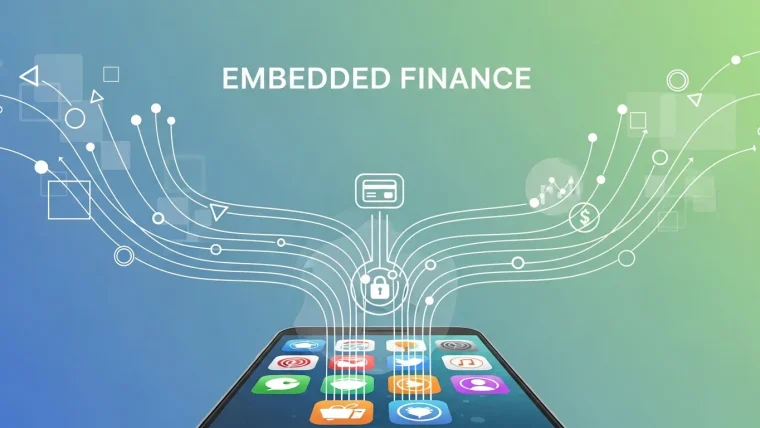


Embedded Finance and the Future of Seamless Digital Financial Services
How AI-Based Fraud Detection is Protecting Digital Payments
Harnessing AI and Machine Learning for Fraud Detection in Digital Finance
Digital Marketing for Financial Services: Strategies That Deliver Results
Digital Twin Technology in Finance: How Virtual Models Are Transforming Risk Management
The Future of Personal Finance: Autonomous Finance and AI Money Management
AI Credit Scoring: Revolutionizing SME Banking and Digital Loans
AI Fraud Detection: How Banks Prevent Financial Crime in Real Time