
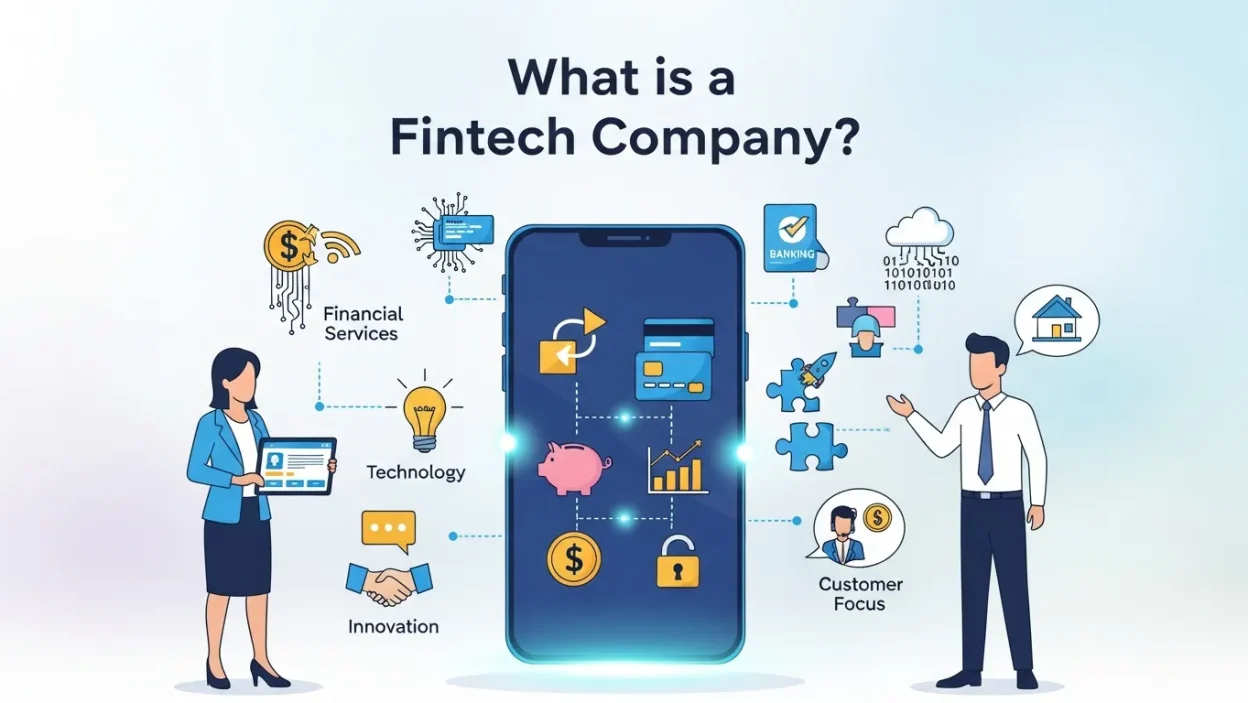
A Fintech Company uses technology to transform financial services, from digital payments and lending to investments, insurance, and blockchain. They improve efficiency, reduce costs, enhance accessibility, and deliver personalized, data-driven solutions. Businesses, marketers, and entrepreneurs benefit from faster transactions, better customer experiences, and insights to optimize operations. By bridging gaps in traditional finance, fintech companies are reshaping the modern economy.
Fintech companies are changing the way we view money. In everything from mobile payments platforms to automated advisors, they use technology to improve the efficiency, automation, and disruption of the traditional banking system. What specifically is a fintech firm, and what are the reasons why marketers, entrepreneurs, and business owners pay attention?
The Basics of Fintech Company
What Does “Fintech” Mean?
“Fintech,” as it is known fintech” is a blend of “financial” and “technology.” Fintech companies are innovators in the financial industry by introducing technological solutions that aim at reducing processes, increasing accessibility and efficiency, as well as reducing costs. Simply put, a fintech firm utilizes software and other technological solutions to offer financial services in innovative and more efficient methods.
The Rise of Fintech
Fintech isn’t new. It’s not a new idea. Credit cards and ATMs were among the earliest examples of financial technology. But today’s technology revolution in finance began in the latter part of 2000, as digital transformation began to impact industries around the world. Smartphones, data analytics, and the internet opened the way for startups with innovative ideas to take on giants in the fields of banking, insurance, and investing.
Today, there are a variety of fintech companies, from multi-billion-dollar companies like PayPal and examples to smaller startups that provide specific services. The investment in fintech has exploded, and the global fintech market is expected to be $698.48 billion in 2030. It is expected to grow at an annual compound growth rate (CAGR) that is 20.3% from 2022 to 2030.
Why Do Fintech Companies Matter?
Fintech companies tackle the issues in conventional financial products, like expensive fees, long procedures, and limited access. They help consumers and businesses alike with simple, cost-effective solutions to manage budgets to approval of small business loans in just a few minutes.
For business owners and marketers, the fintech industry offers solutions that make transactions easier and improve customer experience, and cut operating costs. Knowing the possibilities of fintech solutions could give your company an advantage.
The Strategic Importance of a Fintech Company
A Fintech Company is more than just a technology-driven financial service provider; it is a key player in shaping the modern economy. By combining innovative software solutions with financial expertise, fintech companies are enabling faster, more efficient, and more transparent ways of handling money. They empower individuals, businesses, and startups to access financial tools that were once limited to large institutions.
For entrepreneurs, marketers, and business owners, understanding the role of a Fintech Company is crucial because it allows them to streamline operations, enhance customer experiences, and reduce costs. These firms have the ability to bridge gaps in traditional finance, making services more inclusive, accessible, and personalized.
Key Advantages of a Fintech Company:
-
Improves financial accessibility for underserved populations
-
Automates repetitive processes, reducing operational time
-
Offers data-driven insights for better decision-making
-
Enables global transactions without high overhead costs
-
Enhances customer experience with faster and smoother services
Types of Fintech Company
Fintech firms specialize in many areas of financial services. Here are some of the major areas:
1. Payment Services
Fintech companies operating in the field of payment allow consumers as well as businesses to transfer and receive funds quickly. This includes payment processors that are digital, electronic wallets, as well as peer-to-peer platforms for payment. The major players are:
- PayPal and Venmo are for peer-to-peer transactions that are simple.
- An example of companies to accept online payments.
- Square for small-sized businesses that require point-of-sale solutions.
2. Banking
Neo-banks have redesigned the banking experience for business and personal customers by cutting out physical branches and providing completely digital banking services. Examples include:
- Chime to get fee-free banking for personal use.
- Revolut to make global transfers of funds without hidden charges.
These services cater to young tech-savvy customers who are unhappy with the traditional banking model.
3. Lending and Credit
Fintech lending has transformed the way businesses and consumers take out loans. Algorithms and AI simplify credit checks, which allows for quicker approvals. Platforms such as:
- LendingClub connects investors and borrowers directly.
- Kabbage provides loans quickly to small-scale businesses based on the real-time performance of their business.
These solutions reduce paperwork and make borrowing more personal.
4. Wealth Management and Investments
Fintech companies are helping individuals increase their wealth with little effort by using robo-advisors and applications for trading stocks, as well as cryptocurrency-based platforms. Examples include:
- Improvement as well as Wealthfront both offer algorithm-driven investment advice.
- Robinhood was a platform that made it easier for people to participate in investing by offering commission-free stock trading.
- Coinbase is a top cryptocurrency exchange.
The tools allow people to control their finances easily.
5. Insurtech
Companies in the field of insurance technology, also called insurtechs, make use of data analytics to provide individualized quotes as well as speedy claim processing. Examples such as Lemonade and Hippo are changing the insurance industry by implementing customer-centric methods.
6. Regtech
In industries that face a lot of regulations, regtech firms provide solutions to ensure compliance. This is particularly important for those who are just beginning to navigate the complex financial market. The services typically comprise anti-money laundering monitoring as well as fraud detection.
7. Blockchain and Cryptocurrency
Blockchain technology drives decentralization, eliminating intermediaries in financial transactions. Cryptocurrency-focused fintechs like Binance and Ethereum are improving transparency and offering alternative payment methods.
Comparison of Fintech Company Services vs Traditional Financial Services
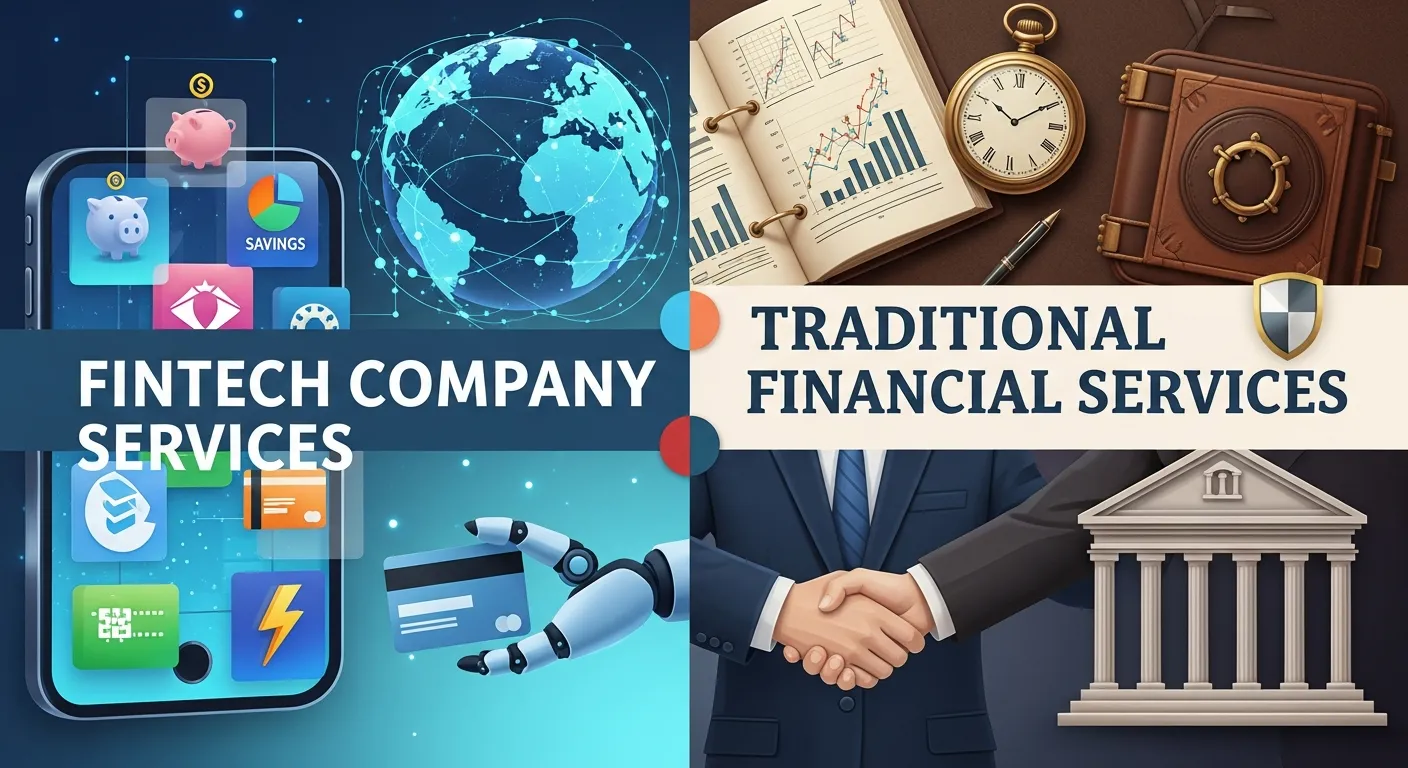
A Fintech Company differentiates itself from traditional financial institutions by focusing on digital-first solutions, rapid innovation, and customer-centric services. Here’s a simple comparison to illustrate the differences:
| Feature | Fintech Company | Traditional Financial Institution |
|---|---|---|
| Service Delivery | Fully digital, app-based | Branch-based with some digital options |
| Transaction Speed | Instant or real-time | Often delayed due to manual procedures |
| Customer Focus | Highly personalized experience | Standardized service |
| Operational Cost | Low overhead, fewer fees | High overhead, higher fees |
| Innovation | Fast adoption of new technologies | Slower technology adoption |
| Accessibility | 24/7 global access | Limited by office hours and locations |
This table highlights how a Fintech Company leverages technology to make financial services faster, cheaper, and more efficient, compared to traditional systems.
Why Marketers and Business Owners Should Care
Enhanced Customer Experience
Fintech technology makes transactions speedier, easier, smoother, and more comfortable. For instance, the ability to accept electronic payments via platform,s such as for instance, or providing finance options through Klarna will increase customer satisfaction and loyalty.
Savings and Efficiency
Small-scale businesses can use Fintech tools to cut costs. Applications like QuickBooks simplify payroll, accounting, and invoicing. Digital wallets can eliminate expensive point-of-sale and charges for processing payments.
Expanding Market Reach
Platforms such as PayPal and Revolut allow international transactions, which allows small-sized businesses to take an international approach. This allows for expansion without needing a significant initial investment.
Data-Driven Insights
Fintech tools can provide analytics to assist businesses in understanding the behavior of their customers. For example, online stores are able to use data from payments to improve their designs, improve traffic, increase sales, and give personalized recommendations.
Leveraging a Fintech Company for Business Growth
Integrating a Fintech Company into your business operations can deliver tangible benefits:
Operational Efficiency:
-
Automates accounting, payroll, and payment processes
-
Reduces manual errors and administrative workload
Customer Engagement:
-
Enables smoother checkout experiences
-
Provides installment or flexible payment options
Market Expansion:
-
Facilitates international transactions easily
-
Opens opportunities for a global customer base
Data Insights:
-
Collects transactional data to understand customer behavior
-
Optimizes marketing strategies based on analytics
By strategically partnering with fintech platforms, businesses can save time, reduce costs, and deliver superior experiences to customers—turning technology adoption into a competitive advantage.
Challenges Fintech Companies Face
Fintech companies are incredibly innovative however, they also face a variety of challenges:
- Regulation Compliance The process of navigating strict regulations, particularly in different markets, is an ongoing challenge.
- Secure Data: The handling of sensitive financial information makes security a top priority.
- Build Trust: In order to convince customers to move away from traditional options to more technologically-driven options requires the creation of trust.
Knowing these issues can assist marketers in recognizing the effort that fintech companies invest in ensuring a smooth and consistent customer experience.
The Future of Fintech
It is clear that the future for fintech is very promising. New trends like the embedded financial system, live-time payment, and AI-driven personalization are expected to revolutionize customer interactions further. In addition, collaborations between fintech companies and banks have expanded the possibilities.
For companies, embracing technology will shift from a competitive advantage to a requirement. Businesses that make use of fintech tools will benefit significantly from streamlined processes to greater access to markets in the world.
How You Can Leverage Fintech for Your Business
If you’re a marketing professional, an entrepreneur, or an owner of a business, this article will show you how you can maximize the use of the fintech tools available:
- Consider payment solutions such as PayPal or others to meet the expectations of customers for speed and ease of use.
- Think about offering installment options via platforms such as Klarna and Afterpay to increase purchasing capacity.
- Utilize QuickBooks to manage your finances, or Square for a seamless point of sale system.
- Spend money on analytics tools offered by fintech platforms in order to better know your customers and help you target your marketing.
If you’re looking to better serve your customers and reduce operational costs or boost the financial planning process, fintech is an innovative tool.
A World of Opportunity

Fintech companies aren’t only technology disruptors. They’re the catalysts for efficiency as well as accessibility and innovation. For entrepreneurs, marketers or business executives, knowing the financial technology ecosystem provides a wealth of opportunities to improve the way they conduct business and connect with the world’s population.
Explore the ever-changing world of fintech and discover ways to incorporate cutting-edge technology into your daily operations.
Conclusion
Fintech Companies are revolutionizing how money is managed, transacted, and invested. They provide efficiency, accessibility, and transparency while challenging traditional banking systems. For businesses and entrepreneurs, leveraging fintech solutions enhances operations, customer engagement, and global market reach. Embracing fintech is no longer optional—it’s essential for growth and innovation in today’s digital economy.
FAQs – Fintech Company
1. What is a Fintech Company?
A Fintech Company is a business that leverages technology to deliver financial services more efficiently. This includes digital payments, lending, investment platforms, insurance, and financial management tools, often making processes faster, more accessible, and cost-effective.
2. Why are Fintech Companies important?
Fintech Companies enhance financial accessibility, reduce transaction costs, speed up processes, and improve customer experiences. They empower individuals, startups, and businesses to access innovative financial solutions that were traditionally limited to large banks.
3. How do Fintech Companies differ from traditional banks?
Unlike banks, fintech firms operate primarily online, focus on customer-centric services, adopt new technologies quickly, reduce overhead costs, and provide personalized, real-time financial solutions. They are agile and scalable compared to traditional institutions.
4. What services do Fintech Companies provide?
Services include digital and peer-to-peer payments, neo-banking, online lending and credit, wealth management, robo-advisors, insurtech, regtech, blockchain, and cryptocurrency platforms, among others.
5. Who benefits from Fintech Companies?
Consumers, entrepreneurs, small and medium businesses, marketers, and investors benefit from faster transactions, affordable financial services, greater access to global markets, and improved data-driven decision-making.
6. What is the role of a Fintech Company in business growth?
Fintech Companies streamline financial operations, automate accounting and payroll, optimize payments, and provide actionable data insights, enabling businesses to reduce costs, improve efficiency, and expand both locally and globally.
7. How do Fintech Companies improve customer experience?
They enhance convenience with instant transactions, personalized dashboards, flexible payment options, intuitive apps, and automated solutions, resulting in higher satisfaction and loyalty among users.
8. Are Fintech Companies secure?
Yes. Most leverage modern technologies such as blockchain, AI, encryption, and multi-factor authentication to ensure secure transactions, protect sensitive data, and prevent fraud.
9. What challenges do Fintech Companies face?
Fintech firms face regulatory compliance across different markets, ensuring cybersecurity, building customer trust, and competing with established financial institutions while staying innovative.
10. Can small businesses benefit from Fintech?
Absolutely. Tools like QuickBooks, Square, and PayPal help small businesses manage finances, reduce payment processing fees, automate accounting, and reach customers globally without heavy infrastructure.
11. How is Fintech transforming traditional banking?
Fintech disrupts banking by offering real-time digital transactions, automation, AI-driven personalization, mobile banking, and open banking platforms, raising customer expectations and driving innovation across the financial sector.
12. What does the future hold for Fintech Companies?
The future includes AI-driven personalization, embedded financial services, real-time payments, blockchain adoption, decentralized finance (DeFi), sustainable financing initiatives, and collaborations with traditional banks to expand offerings.



How AI-Based Fraud Detection is Protecting Digital Payments
Embedded Finance and the Future of Seamless Digital Financial Services
Harnessing AI and Machine Learning for Fraud Detection in Digital Finance
Embedded Finance: How Seamless Financial Services Are Integrating into Everyday Apps
Digital Twin Technology in Finance: How Virtual Models Are Transforming Risk Management
The Future of Personal Finance: Autonomous Finance and AI Money Management
AI Credit Scoring: Revolutionizing SME Banking and Digital Loans
AI Fraud Detection: How Banks Prevent Financial Crime in Real Time