

Digital financial literacy is no longer optional in today’s project-driven, tech-enabled workplace. It empowers project managers and teams to use digital tools for budgeting, forecasting, reporting, and financial decision-making with confidence. By improving transparency, reducing errors, and enabling data-driven planning, digital financial literacy helps organizations control costs, manage risks, and deliver projects more successfully. Investing in training equips teams with the skills needed to navigate complex financial environments and achieve sustainable outcomes.
Digital financial literacy is becoming an essential skill in the modern workplace. It’s no longer just a nice-to-have, especially for project managers and team members who so often have to make those snap decisions about budgets and resources. If your project is experiencing cost overruns, weak financial planning, or poor transparency, it may be worth investing in digital financial literacy training.
What Is Digital Financial Literacy?

Digital financial capability is the ability to use digital tools and technology to enable individuals to manage their finances with more ease. It includes learning how to write, read, and interpret financial information using software, applications, and online websites. This could include budgeting products, finance software, and financial forecasting solutions.
In 2020, financial competency now extends to understanding technology as more industries become digitized. Whether on the Excel end of the spectrum or on a cloud-based financial management software solution, digital financial literacy ensures we’re all capable of making informed financial decisions in a connected, tech-driven world. While improving digital financial literacy is essential, it’s also worth considering whether digitization could cause the next financial crisis.
Why Is Digital Financial Literacy Important?
Funds form the crux of every venture.” Budgeting, resource management, purchasing resources, and financial reporting all need an understanding of the basic money stuff. Do a bit of math (add up the hourly wages and benefits for laborers, sweepers, and equipment operators), and those backyard-pavement solutions to marooned leaves start to look more expensive than they might appear on the surface. A digital tool doesn’t just modernize those tasks; it can reveal inefficiencies, too, and deliver real-time insights into data. With insufficient literacy, teams can face an inability to meet the financial targets and derail the project or result in expensive errors, or, in a worst-case scenario, the project being killed.
The Strategic Value of Digital Financial Literacy in Modern Projects
Digital financial literacy plays a strategic role in ensuring project success in today’s fast-paced, technology-driven environment. As projects become more complex and data-heavy, teams must move beyond basic budgeting knowledge and develop the ability to interpret real-time financial data using digital tools. This capability enables project managers to make timely decisions, anticipate risks, and align financial actions with overall project objectives.
Organizations that prioritize digital financial literacy gain a competitive advantage by improving cost control, accountability, and financial foresight. When teams understand how to use digital dashboards, forecasting tools, and automated reporting systems, financial discussions shift from reactive problem-solving to proactive planning. This shift not only reduces financial surprises but also strengthens confidence among stakeholders and sponsors.Reading continue Digital Twin Technology in Finance
Financial Challenges in Project Management

Even the most skilled project managers will encounter financial hurdles. Digital financial literacy can help address these common challenges:
1. Budget Overruns
One of the most frequent issues in project management is going over budget. Poor planning, inadequate tracking, or lack of visibility into spending can cause costs to spiral out of control.
2. Misaligned Spending and Priorities
When teams are unsure where money is being spent, it often results in funding going to low-priority initiatives instead of the aspects that need immediate attention.
3. Difficulty with Forecasting
Forecasting future financial needs relies on properly analyzing data and trends. Without the skills to use digital tools, this process can feel like guesswork.
4. Limited Transparency
Effective financial reporting ensures stakeholders understand where and why money is being spent. Misinformation or insufficient documentation damages trust and accountability.
How Digital Financial Literacy Training Can Solve These Challenges
Digital financial literacy training can transform how project finances are managed. Here’s how it tackles the above challenges:
Enhanced Budget Management
If you train up your team in tools such as forecasting software or a cloud-based project budget tracker, you can track costs as they come in, mitigating the risk of spending over the odds.For instance, tools such as QuickBooks or Microsoft Dynamics 365 allow for automatic tracking of finances and on-time alerts for budget risks in the early stages.
Data-Driven Forecasting and Planning
With some training, teams can predict financial futures more accurately with data models. Systems such as SAP and Anaplan not merely merge the financials but also makes use of powerful AI-driven predictions that resolves the blind spots.
Improved Reporting and Transparency
Teach your team how to generate and present clear financial reports using tools like Google Data Studio or Tableau. This builds trust among management and stakeholders, showcasing that every dollar spent aligns with strategic goals.
Optimized Spending
Train your team on creating and presenting clean financial reports with programs like Google Data Studio or Tableau. This kind of trust between management and shareholders demonstrates that every dollar of spend is in line with strategic objectives.
Key Digital Financial Skills and Their Impact on Project Outcomes
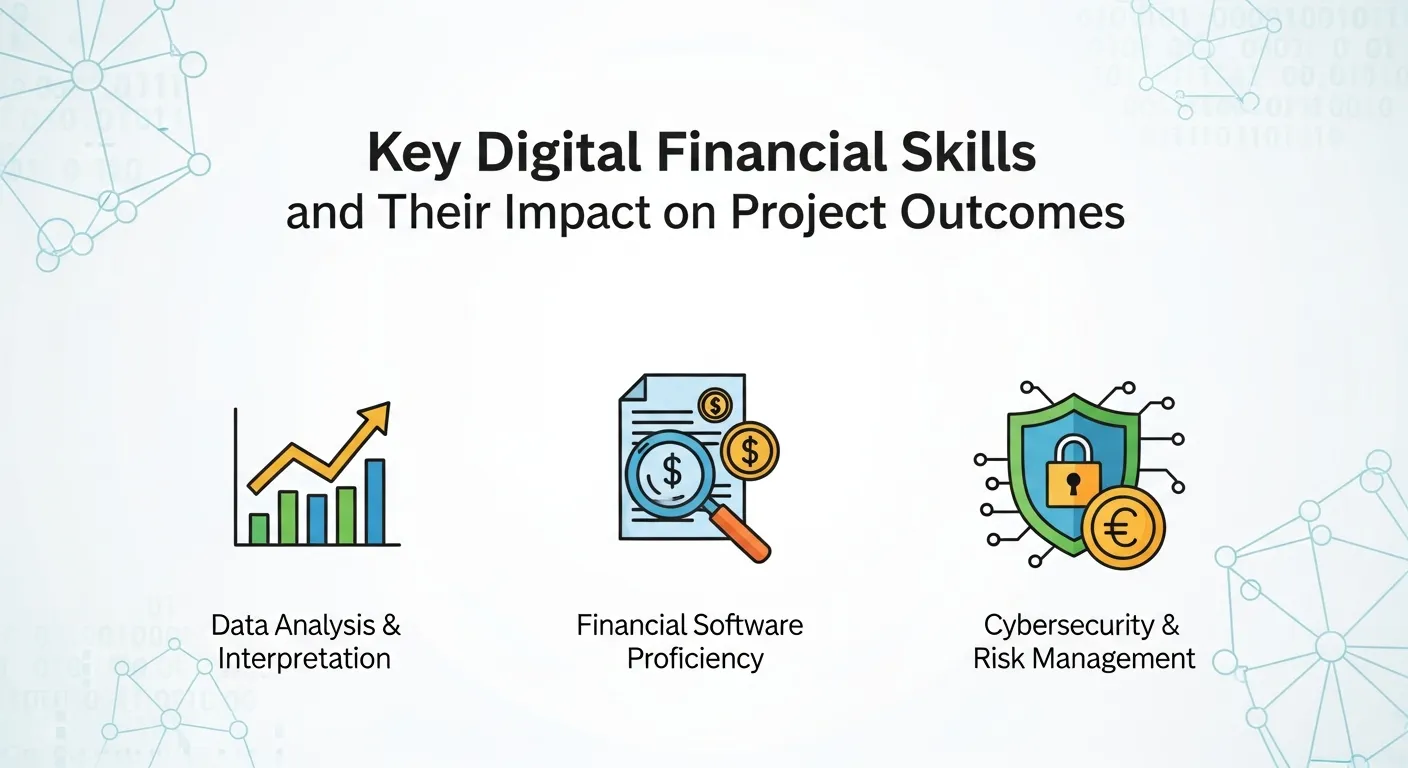
Digital financial literacy is not a single skill but a combination of competencies that directly influence project performance. From understanding financial data to using digital platforms effectively, each skill contributes to better planning, execution, and control. When these skills are embedded into daily project activities, teams are better equipped to manage uncertainty and financial risk.
| Digital Financial Skill | Tools Commonly Used | Impact on Project Performance |
|---|---|---|
| Budget Tracking | Excel, QuickBooks | Reduces cost overruns and improves cost visibility |
| Financial Forecasting | SAP, Anaplan | Enables accurate future planning and risk mitigation |
| Reporting & Dashboards | Tableau, Google Data Studio | Improves transparency and stakeholder trust |
| Expense Control | Xero, FreshBooks | Prevents unnecessary spending and resource waste |
By systematically developing these skills, organizations create financially confident teams that can adapt quickly to change. Instead of relying solely on finance departments, project teams become financially self-sufficient, improving efficiency and reducing communication gaps across departments.
Real-World Examples of Projects Succeeding with Digital Financial Literacy
Many organizations have reaped the rewards of prioritizing financial training. Here are two examples:
Case Study 1: Nonprofit Modernizing Budget Allocations
A nonprofit struggling with consistent budget overruns introduced digital financial literacy training to its staff. By equipping employees with budgeting tools and spending dashboards, the nonprofit saved 15% on general expenses within the first six months and redirected the savings toward core mission programs.
Case Study 2: Software Development Startup
A startup company found its early stages hampered by poor financial decision-making, particularly with vendor payments. After implementing financial training focused on digital tools like QuickBooks and Xero, the team eliminated vendor payment errors and improved profitability by 12%.
These examples highlight how organizations across industries and stages of development can benefit from a digitally savvy staff when it comes to project finances.
Digital Financial Literacy as a Long-Term Capability, Not a One-Time Skill
Many organizations make the mistake of treating digital financial literacy as a one-off training initiative. In reality, it is a long-term capability that evolves alongside technology and business needs. As new tools, platforms, and data sources emerge, teams must continuously update their financial knowledge to remain effective.
-
Treat financial literacy as an ongoing learning process
-
Integrate digital financial tools into daily project workflows
-
Encourage cross-functional financial discussions
-
Reinforce learning through real project data and scenarios
Embedding digital financial literacy into organizational culture ensures sustainable results. This can be achieved by encouraging continuous learning, integrating financial tools into daily workflows, and rewarding data-driven financial decision-making. Over time, this approach transforms financial literacy from an individual skill into a collective organizational strength.
How to Implement Digital Financial Literacy Training in Your Organization
Implementing new training takes careful planning. Follow these steps to help your team strengthen its digital financial literacy skills:
Assess Your Team’s Gaps
Survey team members to evaluate current knowledge of basic finance and digital tools. Identify where they may benefit the most from training.
Select the Right Training Programs
Some popular options include online platforms like Coursera or LinkedIn Learning, which offer courses in financial management and digital tools. Tailor programs to your team’s unique needs.
Use a Blended Learning Approach
Combine online courses with in-person workshops led by trained financial experts. This ensures your team gets the technical support needed to master digital tools.
Leverage On-the-Job Practice
Encourage employees to immediately apply their training to real-world financial tasks. Use case studies, role-playing exercises, or gamified simulations to keep engagement high.
Monitor Progress and Evaluate Success
Track your team’s advancement through progress reports or quizzes. Use KPIs like budget accuracy, timely reporting, and reduced errors to measure the training’s overall impact.
Resources for Getting Started with Digital Financial Literacy Training
If you’re ready to build digital financial literacy within your team or organization, a wide range of accessible resources can help you get started:
Coursera & LinkedIn Learning
These platforms offer beginner to advanced courses in financial literacy, project finance, and digital tools. Many programs cover practical skills such as Excel-based budgeting, QuickBooks accounting, financial analysis, and data visualization. Courses are often self-paced, making them ideal for busy professionals.
Apps and Software Tutorials
Leading financial and analytics tools like Tableau, FreshBooks, Zoho, and similar platforms provide built-in tutorials, user guides, and video walkthroughs. These resources help users quickly learn core features, apply them to real projects, and gain hands-on experience with real financial data.
Specialized Workshops
Industry consultants and training providers offer customized corporate workshops focused on digital finance and project management. These sessions are often tailored to organizational needs, combining financial fundamentals with tool-specific training to deliver immediate, real-world impact.
By combining online learning, practical software tutorials, and targeted workshops, organizations can create a well-rounded digital financial literacy program that supports long-term skill development and confident financial decision-making.
Empower Your Projects with Financial Literacy

Digital financial literacy training is not only about numerical knowledge or learning to use new tools. It’s an investment in the long-term success of your projects and team. With the correct training, project managers and their teams can make better decisions, minimize financial risks, and enhance their operations—doing more with certainty.
You can get started today by checking out a free course or by running an internal workshop. A digitally competent team is not just an investment in financial literacy; it’s an investment in the future of your initiatives.
Conclusion
In an era where projects move fast and financial decisions are increasingly data-driven, digital financial literacy has become a critical success factor. Organizations that invest in building these skills gain clearer financial visibility, stronger control over budgets, and greater stakeholder trust. More importantly, digitally financially literate teams make smarter, faster, and more confident decisions. By prioritizing training and practical application, organizations can turn financial data into a strategic advantage and set their projects up for long-term success.
FAQs on Digital Financial Literacy in Project Management
1. What is digital financial literacy?
Digital financial literacy is the ability to understand, manage, and analyze financial information using digital tools such as spreadsheets, accounting software, dashboards, and forecasting platforms.
2. Why is digital financial literacy important for project managers?
Project managers regularly make decisions about budgets, resources, and timelines. Digital financial literacy helps them control costs, forecast accurately, and reduce financial risks.
3. How does digital financial literacy reduce budget overruns?
It enables real-time tracking, early detection of overspending, and data-driven adjustments before costs escalate.
4. What digital tools are commonly used in financial management?
Common tools include Excel, QuickBooks, SAP, Anaplan, Microsoft Dynamics 365, Tableau, Google Data Studio, and cloud-based budgeting platforms.
5. Can non-finance professionals benefit from digital financial literacy?
Yes. Team members, project leads, and operational staff all benefit by better understanding costs, priorities, and financial impacts of their work.
6. How does digital financial literacy improve transparency?
It allows teams to generate clear, consistent reports that show where money is spent, improving accountability and stakeholder trust.
7. What financial challenges does digital literacy help solve?
It helps address budget overruns, poor forecasting, misaligned spending, and lack of financial visibility.
8. Is digital financial literacy only about learning software?
No. It also involves understanding financial concepts, interpreting data, and applying insights to real-world decisions using digital tools.
9. How long does it take to build digital financial literacy?
Basic skills can be developed in weeks through focused training, while advanced proficiency grows with ongoing practice and real-world application.
10. What industries benefit most from digital financial literacy?
All industries benefit, but it is especially valuable in project-based sectors such as construction, IT, healthcare, nonprofits, and consulting.
11. How can organizations start digital financial literacy training?
They can begin by assessing skill gaps, selecting relevant courses or workshops, and encouraging hands-on use of financial tools.
12. What is the long-term impact of digital financial literacy on organizations?
It leads to better decision-making, reduced financial risk, improved project outcomes, and stronger overall organizational performance.



How AI-Based Fraud Detection is Protecting Digital Payments
Embedded Finance and the Future of Seamless Digital Financial Services
Harnessing AI and Machine Learning for Fraud Detection in Digital Finance
Embedded Finance: How Seamless Financial Services Are Integrating into Everyday Apps
Digital Twin Technology in Finance: How Virtual Models Are Transforming Risk Management
The Future of Personal Finance: Autonomous Finance and AI Money Management
AI Credit Scoring: Revolutionizing SME Banking and Digital Loans
AI Fraud Detection: How Banks Prevent Financial Crime in Real Time