

Artificial intelligence (AI) is transforming financial decision making, making personalized, data-driven guidance accessible to everyone. From investment strategies and loan approvals to budgeting and insurance, AI analyzes vast datasets to reduce errors, minimize bias, and provide predictive insights. Combined with human judgment, AI enables smarter, faster, and more inclusive financial choices.
Financial decisions once required human expertise developed through years of training and experience. Today, artificial intelligence transforms this landscape dramatically, democratizing sophisticated financial analysis for everyday users.
The shift is remarkable and accelerating.
From mortgage approvals to retirement planning, AI systems increasingly influence or directly make financial decisions that impact millions of lives daily. This evolution brings both tremendous opportunities and significant challenges worth understanding.
How AI Changes Financial Decision Making
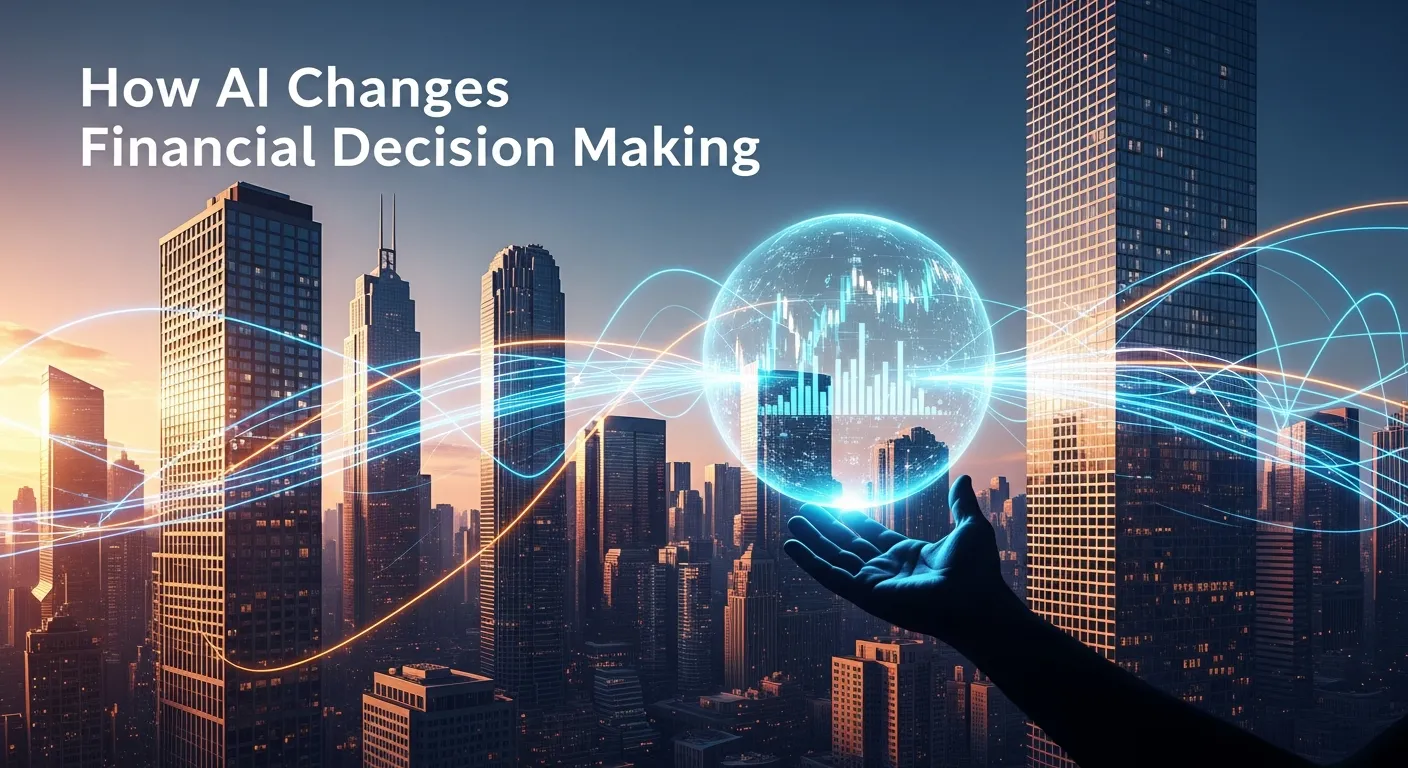
Traditional financial decisions followed relatively rigid frameworks. Loan officers applied standardized criteria. Investment advisors followed established models based on risk tolerance questionnaires. Insurance providers categorized applicants using strict actuarial tables.
AI introduces unprecedented flexibility and personalization.
Today’s systems analyze thousands of data points to create uniquely tailored recommendations. They detect subtle patterns invisible to human analysis. They adapt continuously as new information becomes available.
This shift fundamentally alters the decision-making landscape.
According to research from Accenture, financial institutions implementing AI-driven decision systems report up to 20% lower operational costs and 20% higher customer satisfaction scores.
The technology enables analysis at scales previously impossible.
Financial Decision Making in the AI Era
Financial decision making has entered a transformative phase with artificial intelligence. Decisions that once relied heavily on human intuition and limited datasets now leverage advanced algorithms capable of processing vast amounts of information. This shift ensures more accurate, timely, and personalized financial insights for both individuals and institutions.
(inside para or just below):
-
Real-time analysis for smarter Financial Decision Making.
-
Predictive insights for investments, loans, and insurance.
-
Minimization of errors and human bias in routine financial tasks.
Personalized Financial Guidance
Perhaps the most visible AI application affects personal financial management. Sophisticated algorithms now provide individualized guidance previously available only to wealthy clients.
Robo-advisors represent the vanguard of this movement.
These platforms build investment portfolios based on your specific goals, risk tolerance, and time horizon. They automatically rebalance assets, harvest tax losses, and adjust strategies as market conditions evolve.
The personalization extends beyond investments.
AI-powered budgeting tools analyze spending patterns to identify savings opportunities uniquely relevant to your habits. They predict upcoming expenses based on historical behavior. They suggest timing for major purchases based on price trend analysis.
This guidance becomes increasingly conversational and accessible.
Natural language processing allows users to ask complex financial questions in plain language. “Can I afford a vacation this summer?” prompts analysis of current savings, projected income, and historical spending patterns to provide nuanced answers.
Expanded Accessibility in Financial Decision Making

AI is democratizing financial decision making, giving individuals access to expertise once reserved for top-tier advisors. Today, anyone with a smartphone can leverage AI tools to make informed choices about investments, budgeting, and credit—leveling the playing field in personal finance.
| Feature | Traditional Access | AI-Enhanced Access |
|---|---|---|
| Investment advice | High-net-worth individuals only | Anyone with internet access |
| Credit risk assessment | Manual evaluation by banks | Automated evaluation using diverse data |
| Expense tracking & budgeting | Manual spreadsheets & apps | AI-powered, personalized insights |
| Fraud detection | Reactive, human-driven | Proactive, real-time AI monitoring |
With AI, financial expertise becomes more accessible:
-
Barriers to expert financial guidance are significantly reduced.
-
Lending decisions become more inclusive through alternative data.
-
Portfolio management and budgeting gain greater transparency and personalization.
Risk Assessment Revolution
Lending decisions historically relied on relatively simple metrics like credit scores and income verification. AI systems now evaluate hundreds of variables to assess repayment probability with remarkable accuracy.
The implications are significant.
Millions previously excluded from financial services now receive fair consideration. Alternative data sources like rental payment history, utility bill consistency, and even digital footprints provide insights into creditworthiness beyond traditional scoring models.
At Digitafin, we’ve seen how these advanced risk assessment approaches open opportunities for previously underserved populations while maintaining sound lending practices.
Fraud detection similarly benefits from AI advancement.
Systems continuously monitor transaction patterns, identifying suspicious activities with incredible precision. They distinguish between genuine customer behavior changes and potential fraud signals, reducing both financial losses and false alarms.
Insurance underwriting undergoes similar transformation.
AI algorithms assess risk factors with unprecedented nuance, creating more accurate pricing models. Telematics data enables auto insurers to evaluate actual driving behavior rather than demographic proxies. Health insurers leverage lifestyle data to incentivize preventative care.
The Human-AI Partnership
Despite remarkable progress, optimal financial outcomes typically emerge from human-AI collaboration rather than pure automation.
Each brings complementary strengths.
AI excels at processing vast amounts of information, identifying subtle patterns, and applying consistent analytical frameworks. Humans contribute contextual understanding, value judgments, and emotional intelligence essential for major financial decisions.
Financial advisors increasingly leverage AI as powerful assistants.
Rather than feeling threatened by automation, forward-thinking professionals embrace these tools to enhance their capabilities. They focus on relationship building and complex planning while AI handles data analysis and routine tasks.
This partnership model appears most effective.
According to a McKinsey Global Institute study, financial services see the greatest impact when AI augments human capabilities rather than replacing them entirely.
The most successful implementations maintain appropriate human oversight.
Human-AI Collaboration in Financial Decision Making
AI is reshaping Financial Decision Making, but human expertise remains essential. Advisors now interpret AI insights, provide strategic guidance, and offer the emotional intelligence necessary for complex decisions. This combination ensures well-rounded and context-aware financial outcomes.
-
AI handles data-intensive tasks; humans provide strategy and judgment.
-
Emotional intelligence remains key in client relationships.
-
Synergistic collaboration improves trust in Financial Decision Making.
Ethical Considerations and Challenges

Despite tremendous benefits, AI-powered financial decision systems raise important ethical questions demanding thoughtful consideration.
Algorithmic bias represents a significant concern.
When trained on historical data reflecting past discriminatory practices, AI systems risk perpetuating these biases at scale. Vigilant testing, diverse training data, and careful monitoring help mitigate these risks.
Transparency presents another challenge.
Many advanced AI systems function as “black boxes” where even their creators cannot fully explain specific decisions. This opacity creates legitimate concerns in consequential financial contexts like loan approvals or insurance coverage.
Privacy considerations grow increasingly complex.
AI systems derive insights from vast personal data repositories. Finding the right balance between personalization benefits and privacy protection remains an ongoing challenge requiring both technical and policy solutions.
Regulatory frameworks continue evolving to address these issues.
Financial authorities worldwide develop guidelines addressing algorithmic accountability, required disclosures, and appropriate human oversight. These frameworks will significantly shape AI implementation in coming years.
The Future of AI in Financial Decision Making
Several emerging trends suggest where AI-powered financial decision making heads next.
Emotional intelligence represents a growing frontier.
Advanced systems increasingly recognize emotional cues in text and voice interactions, adapting responses accordingly. This capability proves particularly valuable when discussing sensitive financial matters or during periods of market volatility.
Anticipatory guidance grows more sophisticated.
Rather than merely responding to direct questions, AI systems proactively identify potential opportunities or concerns based on changing personal circumstances or market conditions. They suggest appropriate actions before problems develop.
Increased democratization continues expanding access.
Tools previously available only to financial professionals or wealthy individuals become accessible to broader populations. This democratization potentially reduces wealth gaps by providing quality guidance regardless of economic status.
Decentralized finance integration accelerates.
AI systems increasingly connect with blockchain-based financial protocols, enabling automated decision execution across traditional and decentralized financial systems. This convergence creates powerful new capabilities for sophisticated portfolio management.
Implementing AI in Your Financial Life
For individuals seeking to benefit from AI-powered financial decision making, several practical steps provide a starting point:
Explore robo-advisory platforms for investment management. These services offer sophisticated portfolio construction at fraction of traditional costs. Many provide tiered service models allowing human consultation for complex questions.
Try AI-powered budgeting applications that analyze spending patterns and suggest personalized improvements. These tools identify opportunities invisible to casual observation.
Consider lenders utilizing alternative data for major purchases if traditional credit metrics don’t reflect your true financial responsibility.
Investigate insurance providers employing behavior-based pricing models that may reward your actual risk profile rather than demographic averages.
Start with smaller financial decisions while building comfort with AI recommendations before relying on these systems for major life choices.
Finding the Right Balance

As AI continues transforming financial decision making, finding the right human-machine balance remains essential. The most successful approaches treat AI as a powerful tool rather than an infallible oracle.
The technology excels at what computers traditionally do best: processing vast information, identifying patterns, performing complex calculations, and maintaining consistent analytical frameworks.
Human judgment remains invaluable for contextual understanding, value-based trade-offs, and emotional factors inherent in major financial decisions.
The future belongs neither to pure human intuition nor complete algorithmic delegation.
Rather, it emerges from thoughtful integration leveraging the strengths of both. This hybrid approach – combining computational power with human wisdom – likely delivers the best financial outcomes for most people.
By understanding AI’s capabilities and limitations in financial contexts, you position yourself to benefit from this technological revolution while maintaining appropriate agency over your financial future.
Conclusion – Financial Decision Making
Financial decision making is undergoing a profound transformation thanks to AI-driven tools that improve accuracy, efficiency, and accessibility. From personalized investment guidance to advanced risk assessment, AI enables individuals and institutions to make more informed decisions at scale.
Despite these advancements, human oversight remains essential. Contextual understanding, value-based judgment, and emotional intelligence cannot be fully replicated by algorithms. The most effective financial strategies emerge from a collaboration between AI and human expertise, where technology handles complex data analysis and pattern recognition, while humans provide strategic insight and ethical guidance.
This hybrid approach empowers smarter, more personalized, and fairer decision making across investments, lending, budgeting, and broader personal finance management. As AI continues to evolve, embracing its capabilities alongside human judgment will be key to navigating the future of financial decision making with confidence and responsibility.
FAQs – Financial Decision Making
1. What is financial decision making?
Financial decision making involves evaluating options and choosing strategies related to investments, loans, budgeting, savings, and insurance. It relies on data analysis, personal or organizational goals, and risk tolerance to optimize financial outcomes.
2. How is AI changing financial decision making?
AI transforms financial decision making by analyzing vast datasets, identifying patterns invisible to humans, predicting potential outcomes, and providing personalized recommendations. This improves decision accuracy, speed, and efficiency.
3. What are robo-advisors?
Robo-advisors are AI-powered platforms that design, monitor, and manage customized investment portfolios. They consider your goals, risk tolerance, and time horizon, automatically rebalancing assets and adjusting strategies as markets change.
4. Can AI improve budgeting and personal finance?
Yes. AI tools track spending patterns, forecast upcoming expenses, suggest personalized saving strategies, and optimize cash flow. They make personal finance management more proactive and insightful.
5. Does AI reduce human error in financial decisions?
Absolutely. AI minimizes errors and biases in routine financial tasks such as credit evaluation, fraud detection, portfolio management, and automated reporting, ensuring more consistent and reliable results.
6. Who benefits most from AI in financial decision making?
Everyone can benefit. Individuals gain personalized financial insights, small businesses optimize cash flow, and large institutions improve investment strategies, risk management, and operational efficiency.
7. Can AI make lending more inclusive?
Yes. By incorporating alternative data like rental history, utility payments, or digital behavior, AI assesses creditworthiness beyond traditional scores, providing fair access to loans for previously underserved populations.
8. Is human oversight still needed with AI financial tools?
Yes. While AI excels in data processing and analysis, human judgment is essential for context, strategic decision-making, ethical considerations, and emotional intelligence in complex financial situations.
9. What are the risks of AI in financial decision making?
Risks include algorithmic bias, privacy violations, lack of transparency, over-reliance on automated systems, and potential regulatory challenges. Ethical design and human supervision are crucial to mitigate these risks.
10. How does AI detect fraud?
AI monitors financial transactions in real time, identifies unusual or suspicious patterns, and distinguishes between legitimate changes in behavior and fraudulent activity, reducing financial losses and false alarms.
11. Can AI predict investment outcomes?
AI provides predictive insights based on historical trends, market data, and real-time signals, helping investors make informed decisions. However, predictions are probabilistic and cannot guarantee returns.
12. How should individuals start using AI for financial decisions?
Begin with smaller tools like budgeting apps, robo-advisors, or automated credit monitoring. Gradually expand usage as you gain confidence, while keeping human oversight for major investments or long-term financial planning.




The Future of Personal Finance: Autonomous Finance and AI Money Management
The Role of AI in Digital Financial Decision Making
What is a Fintech Company?
What is a Fintech Firm? Everything You Need to Know
Digital Twin Technology in Finance: How Virtual Models Are Transforming Risk Management
The Future of Personal Finance: Autonomous Finance and AI Money Management
AI Credit Scoring: Revolutionizing SME Banking and Digital Loans
AI Fraud Detection: How Banks Prevent Financial Crime in Real Time