
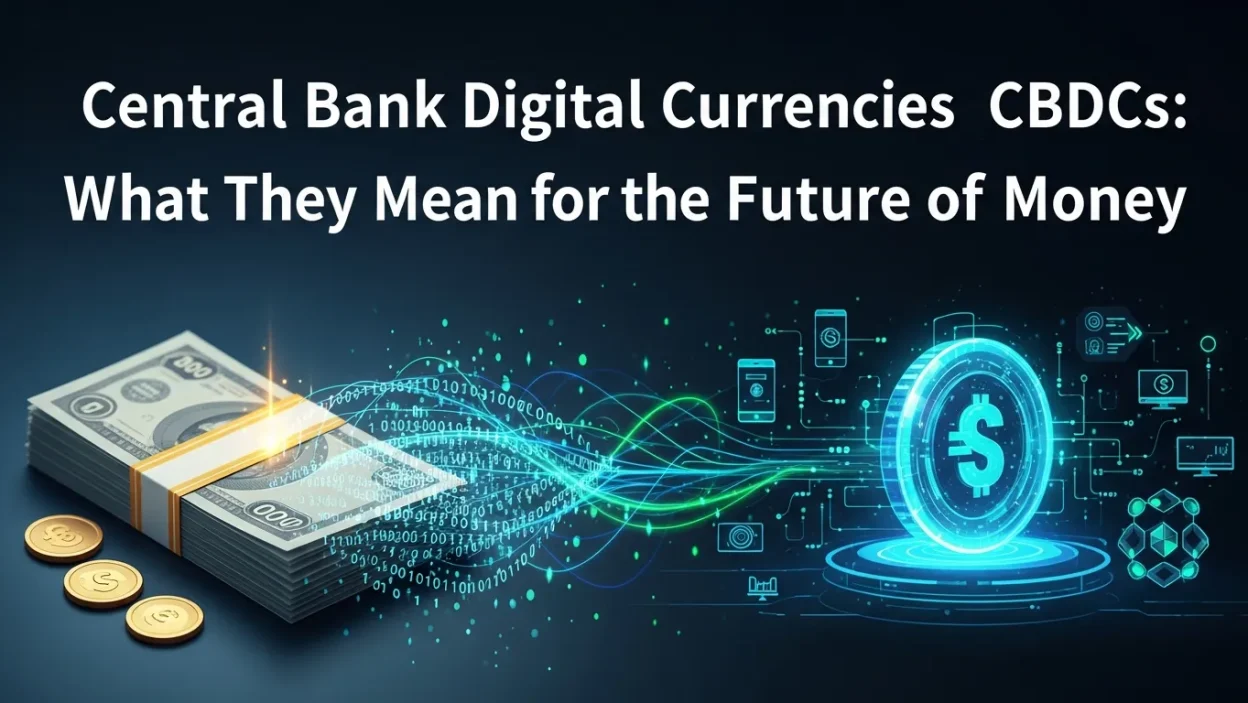
Central Bank Digital Currencies (CBDCs) are transforming the future of money by combining the security of government-backed currency with the efficiency of digital transactions. Unlike traditional cash or commercial bank deposits, CBDCs are digital liabilities of the central bank, enabling faster payments, greater financial inclusion, programmable money, and real-time economic policy implementation. As digital currencies gain traction globally, they have the potential to reshape banking, monetary policy, and everyday financial interactions, offering a more inclusive and efficient financial ecosystem.
Money has evolved dramatically throughout human history. From shells and precious metals to paper notes and digital transactions, each evolution reflects changing social needs and technological capabilities.
Central Bank Digital Currencies (CBDCs) represent potentially the most significant transformation of money in generations. Unlike cryptocurrencies such as Bitcoin, these are digital versions of national currencies, issued and regulated by a country’s monetary authority.
The implications stretch far beyond simple digitization.
Why Central Bank Digital Currencies Are the Future of Money
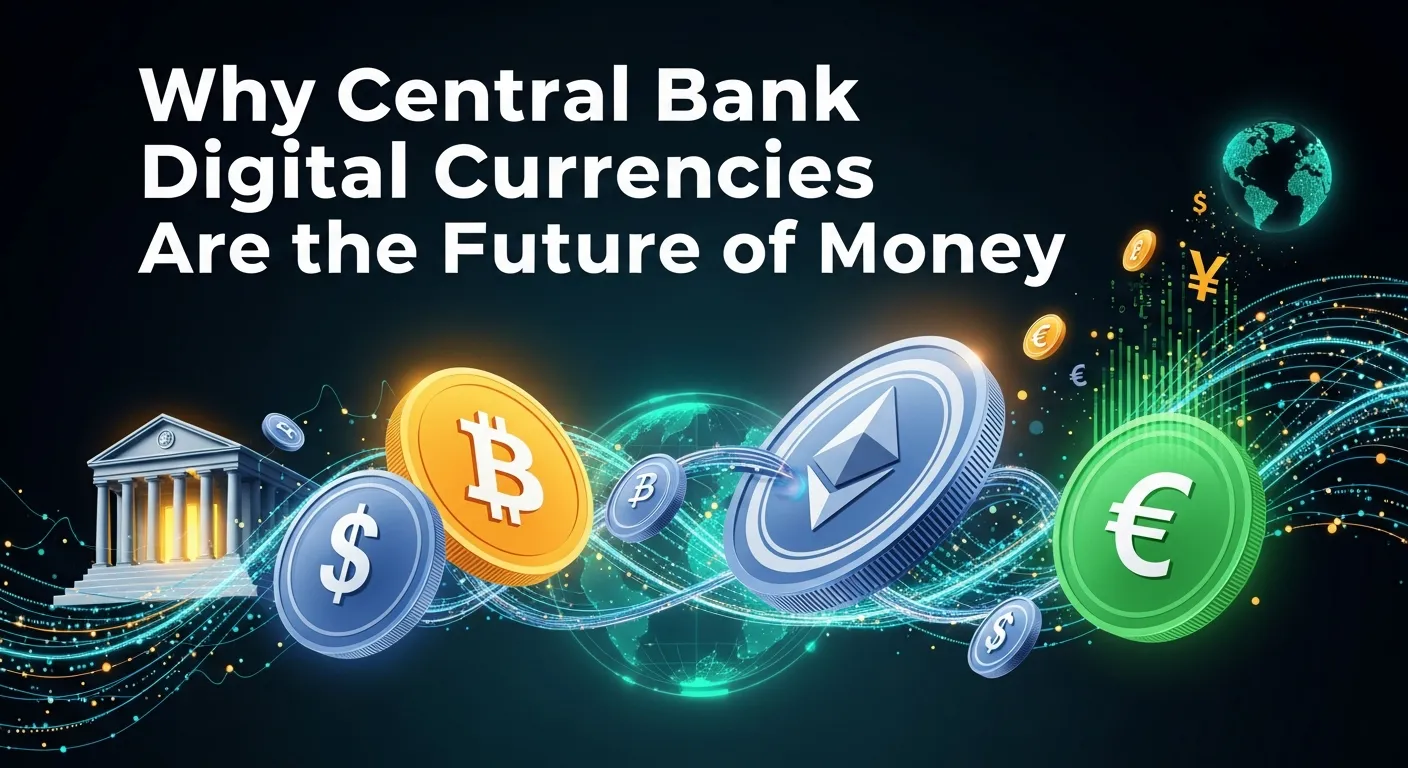
Central Bank Digital Currencies (CBDCs) represent a fundamental shift in the way money functions. Unlike traditional cash or commercial bank deposits, CBDCs are digital liabilities of the central bank, combining the trust of government-backed currency with the speed and convenience of modern technology. The Future of Money increasingly leans toward digitization, and CBDCs offer a pathway to a more secure, efficient, and inclusive financial ecosystem.
-
CBDCs reduce counterparty risk by being direct claims on the central bank.
-
Digital wallets enable instant peer-to-peer transactions without intermediaries.
-
They provide governments with real-time visibility into monetary flows for economic planning.
| Feature | Traditional Money | CBDCs |
|---|---|---|
| Form | Physical notes & coins | Digital tokens |
| Settlement | Bank intermediaries | Instant, direct central bank settlement |
| Accessibility | Limited by banking infrastructure | Broad access via digital wallets & mobile phones |
| Policy Implementation | Slow & indirect | Direct and programmable for rapid stimulus |
Understanding CBDCs: Digital Cash for a Digital Era
CBDCs essentially function as digital versions of physical cash, but with important differences that make them uniquely powerful.
They combine the convenience of digital payments with the security of central bank money.
Unlike commercial bank deposits, CBDCs represent a direct claim on the central bank, eliminating counterparty risk. Think of them as digital dollar bills that exist in a secure digital wallet rather than your physical one.
The technological architecture varies by country and implementation.
Some CBDCs operate on distributed ledger technology similar to cryptocurrencies. Others use more centralized systems. Each approach offers different tradeoffs between efficiency, security, and privacy.
What makes CBDCs revolutionary isn’t just their digital nature – it’s their potential to fundamentally reshape banking, monetary policy, and financial inclusion.
The Global Race for Digital Currency Dominance
Nearly 130 countries representing 98% of global GDP are currently exploring CBDCs. This isn’t merely technological experimentation – it reflects shifting geopolitical realities.
China leads the charge with remarkable determination.
The digital yuan (e-CNY) has already seen trials involving millions of citizens and transactions worth billions. According to the Bank for International Settlements, China’s motivation extends beyond domestic efficiency to international influence.
Other major economies are accelerating their efforts in response.
The European Central Bank’s digital euro project continues advancing through development phases. The Federal Reserve’s “Project Hamilton” explores technical capabilities for a potential digital dollar. India, Brazil, and many others have announced concrete CBDC initiatives.
This competition reflects recognition that early adopters may help shape international standards and enhance their currency’s global role.
How CBDCs Will Transform Everyday Transactions

The Future of Money is not just abstract—it directly affects daily life. Central Bank Digital Currencies could make payments faster, cheaper, and more secure. Person-to-person transfers that once took days may become instantaneous. Small online transactions and micropayments could be handled efficiently, bypassing traditional card networks and their fees.
-
Cross-border payments could settle in real-time.
-
Digital wallets may provide direct access to central bank money.
-
Programmable features enable automatic government payments, tax collection, and stimulus distribution.
| Benefit | Description | Impact on Citizens |
|---|---|---|
| Instant Settlements | Transactions clear in seconds | Faster commerce and liquidity |
| Reduced Fees | Eliminate middlemen costs | More affordable for individuals & businesses |
| Financial Inclusion | Accessible via mobile devices | Greater access for unbanked populations |
| Programmable Money | Conditional transactions (e.g., stimulus) | Automatic and precise economic interventions |
CBDCs have the potential to redefine how money flows in everyday life, making financial systems more inclusive and responsive.
How CBDCs Will Impact Everyday Financial Life
For ordinary citizens, CBDCs could transform daily financial interactions in both obvious and subtle ways.
Payments would become faster and potentially cheaper.
Person-to-person transfers that currently take days might settle instantly, even across borders. Micropayments for small online transactions could become economically viable without fee-heavy card networks.
Banking relationships might fundamentally change.
CBDCs could enable direct accounts with the central bank, potentially challenging the traditional banking model. Some designs include tiered approaches where banks maintain customer relationships while the central bank provides the underlying infrastructure.
Financial inclusion represents a significant potential benefit.
For billions globally who lack adequate banking services, CBDCs could provide essential financial access through basic mobile phones. According to the World Bank, approximately 1.4 billion adults remain unbanked, yet two-thirds own mobile phones.
The possibility of programmable money introduces fascinating capabilities.
Government benefits could automatically route to qualified recipients. Tax payments could be integrated seamlessly into transactions. Time-limited stimulus funds could ensure immediate economic impact during crises.
Privacy Concerns and Civil Liberties
Despite potential benefits, CBDCs raise profound privacy questions that societies must address deliberately.
Physical cash provides anonymity that digital systems typically don’t.
Current CBDC designs offer varying privacy protections. Some propose zero-knowledge proof systems that validate transactions without revealing identities. Others embrace full traceability as a feature rather than a limitation.
The balance between combating financial crime and protecting civil liberties requires careful calibration.
Transparency about data collection, storage, and usage policies must be established before widespread implementation. Independent oversight mechanisms should provide accountability for how transaction data is utilized.
These concerns extend beyond technical design to fundamental questions about state power and individual autonomy in the digital age.
Economic Implications and Monetary Policy
CBDCs offer central banks unprecedented tools for implementing monetary policy with surgical precision.
Interest rates could be adjusted instantly across the entire economy.
During economic downturns, stimulus funds could reach citizens within minutes rather than weeks. Targeted economic interventions could address specific regions or sectors experiencing difficulties.
Banking systems would face significant adjustments.
If consumers can hold digital currency directly with central banks, commercial banks might see deposit bases erode. This could impact lending capacity unless carefully managed through transitional policies.
At Digitafin, we’ve analyzed how these shifts could transform investment strategies and financial planning for forward-thinking clients preparing for this new monetary landscape.
International capital flows might become simultaneously more efficient and more controllable.
Cross-border transactions could settle faster with lower fees. However, capital controls could also be implemented more effectively through programmable restrictions within the CBDC system itself.
Crypto Coexistence: CBDCs and Private Digital Currencies

The relationship between CBDCs and cryptocurrencies remains complex and evolving.
They serve fundamentally different purposes.
Bitcoin emerged partly as a response to centralized monetary control. CBDCs, by definition, embrace that centralization while incorporating digital efficiency. One represents a challenge to monetary authority; the other extends it.
Yet they may coexist in complementary roles.
Private stablecoins might interface with CBDC systems through regulated pathways. Decentralized finance applications could build services atop CBDC infrastructure while maintaining innovation at the application layer.
Central banks increasingly recognize this potential symbiosis.
Many are designing systems that allow for public-private partnerships. These hybrid approaches maintain central bank oversight while leveraging private sector innovation and customer relationships.
Implementation Challenges and Technological Barriers
Despite enthusiasm, significant hurdles remain before CBDCs become mainstream reality.
Technical infrastructure demands are substantial.
Systems must handle enormous transaction volumes with near-perfect reliability and security. The computational requirements for nationwide CBDC networks exceed most existing payment systems by orders of magnitude.
Digital inclusion concerns persist despite potential benefits.
Not everyone has reliable internet access or digital literacy. CBDCs must accommodate offline functionality and simplified interfaces to avoid creating new forms of financial exclusion.
Cross-border interoperability presents complex challenges.
Different national systems must communicate effectively without compromising security or sovereignty. International standards are emerging, but consensus remains elusive on key design principles.
Planning for a CBDC Future
Organizations and individuals should begin preparing for this monetary evolution, even amid uncertainty about specific implementations.
Financial institutions need strategic repositioning.
Banks should explore value-added services beyond basic deposit-taking. Payment processors must identify new roles in a CBDC ecosystem. Investment firms should consider portfolio implications of changing monetary transmission mechanisms.
Businesses should evaluate operational adjustments.
Payment systems will require updates to accommodate new digital currency formats. Treasury operations might need restructuring to leverage programmable money features and instant settlement.
Individuals benefit from digital financial literacy.
Understanding secure wallet management, recognizing the differences between various digital currencies, and protecting personal financial data will become essential skills in a CBDC world.
The Road Ahead
CBDCs stand poised to transform money more fundamentally than any innovation since paper currency. Their development represents not merely technological evolution but a reconfiguration of financial relationships between citizens, banks, and governments.
The next five years will prove decisive.
Early implementations will establish precedents and reveal unforeseen consequences. Public acceptance will determine adoption trajectories. Regulatory frameworks will crystallize around emerging best practices.
What remains certain is that money itself is changing.
The abstract social technology that enables cooperative exchange among humans is undergoing its next metamorphosis. As with previous monetary evolutions, this transformation will reflect our collective values, priorities, and technological capabilities.
Understanding these changes isn’t merely academic – it’s essential preparation for navigating the financial landscape of tomorrow.
Conclusion
The rise of Central Bank Digital Currencies marks a pivotal moment in the evolution of money. These digital currencies promise faster transactions, reduced costs, improved financial inclusion, and enhanced monetary control. While challenges around privacy, infrastructure, and digital literacy remain, CBDCs are poised to redefine the future of money for individuals, businesses, and governments alike. Preparing for this transformation is essential for navigating the increasingly digital financial landscape.
Frequently Asked Questions-Central Bank Digital Currencies & Digital Currencies
1. What are Central Bank Digital Currencies (CBDCs)?
Central Bank Digital Currencies (CBDCs) are digital forms of national currency issued and fully regulated by central banks. Unlike regular bank deposits, CBDCs are direct liabilities of the central bank, combining the trust and legal recognition of government-backed money with the speed, convenience, and accessibility of digital payments.
2. How do CBDCs differ from cryptocurrencies like Bitcoin?
While cryptocurrencies like Bitcoin are decentralized, unregulated, and highly volatile, CBDCs are centralized, stable, and legally recognized. They operate under government oversight, ensuring regulatory compliance, financial security, and wide-scale acceptance.
3. Why are CBDCs considered the future of money?
CBDCs represent the future of money by enabling instant settlements, reducing transaction costs, increasing financial inclusion, and offering programmable money features. They have the potential to reshape traditional banking, payment systems, and the way individuals and businesses manage financial transactions globally.
4. What benefits do digital currencies provide to citizens?
Digital currencies like CBDCs can make payments faster, cheaper, and more secure. Citizens may enjoy direct access to central bank accounts, efficient cross-border transfers, financial services through mobile devices, and programmable payments that automate taxes, government benefits, or stimulus funds.
5. How will CBDCs impact banking systems?
CBDCs could reduce the reliance on commercial banks for deposit-holding. While banks may still manage customer relationships and provide loans, direct access to central bank digital money could shift the structure of traditional banking, prompting innovation and operational adaptation.
6. Are CBDCs secure?
Yes. CBDCs are designed with strong cybersecurity measures, often using distributed ledger technology or highly secure centralized systems. They include safeguards against fraud, cyberattacks, and unauthorized access, ensuring digital currency transactions are safe and reliable.
7. Can CBDCs improve financial inclusion?
Absolutely. Digital currencies can provide millions of unbanked and underbanked individuals access to basic financial services through digital wallets or mobile phones. This improves access to payments, savings, and government benefits, helping bridge global financial gaps.
8. What privacy and civil liberties concerns exist with CBDCs?
CBDCs could allow governments to monitor transactions in real time, potentially reducing anonymity. Designs vary, from systems that allow traceable transactions for compliance to privacy-focused solutions that limit identifiable data. Ensuring transparency, accountability, and user trust is critical in balancing privacy and security.
9. How do CBDCs affect cross-border payments?
Digital currencies make international payments faster, cheaper, and more efficient. Cross-border transfers can settle instantly with fewer intermediaries, reducing fees and delays. Over time, standardized CBDC systems may enable smoother global financial interactions.
10. Will CBDCs replace cash completely?
Not immediately. Central Bank Digital Currencies are intended to complement, not entirely replace, physical cash. Both forms of money can coexist, allowing gradual integration into everyday financial activities while preserving the benefits of cash where needed.
11. How do programmable digital currencies work?
Programmable CBDCs allow governments and organizations to automate payments or impose conditions on transactions. Examples include automatic stimulus distribution, conditional government benefits, or automated tax collection, enabling precise and efficient monetary interventions.
12. Which countries are leading the development of CBDCs?
China (digital yuan/e-CNY) has conducted large-scale trials, while the European Union (digital euro), the USA (Project Hamilton), India, Brazil, and nearly 130 other countries are exploring pilot programs. Early adopters are likely to shape global standards and influence the future of money.





Embedded Finance and the Future of Seamless Digital Financial Services
The Importance of Risk Management in Modern Business
How Financial Technology Is Transforming Digital Payments
What Is Financial Technology (FinTech)? Everything You Need to Know
The Importance of Risk Management in Modern Business
How Financial Technology Is Transforming Digital Payments
How Digital Banking Is Changing the Future of Financial Management
How Financial Consulting Supports Sustainable Business Growth